Key Points
- Emergency services responded to a serious collision involving a bus and a pedestrian on Vicar Lane in Leeds city centre.
- The incident took place at approximately 10:24 am on Wednesday, 4 November 2026.
- The pedestrian involved, a man believed to be in his 60s, sustained injuries and was treated by ambulance crews before being transported to hospital.
- Police confirmed that the casualty’s injuries are not considered life-threatening.
- West Yorkshire Police and the Yorkshire Ambulance Service implemented a temporary road closure and set up a police scene while emergency personnel managed the situation.
- The road was successfully cleared and reopened to all vehicular traffic around 11:15 am, mitigating further transport disruption across the city.
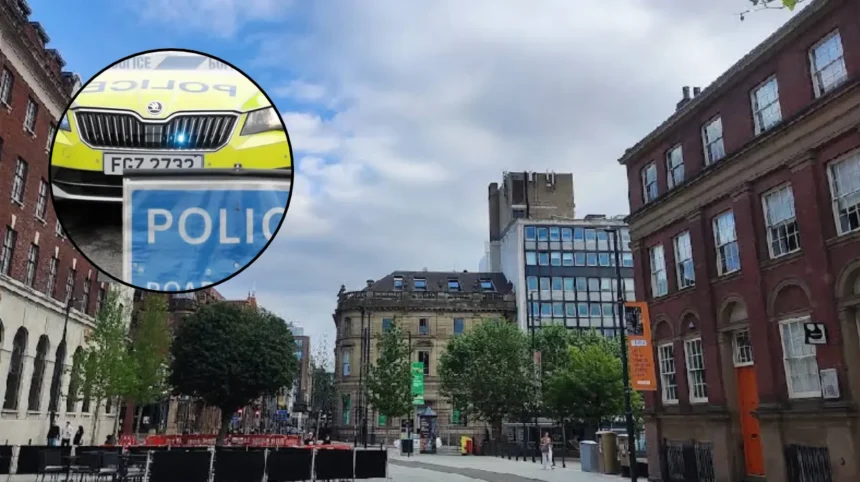
LEEDS CITY CENTRE (The Leeds Times) November 4, 2026 — A major transport corridor in West Yorkshire was briefly cordoned off on Wednesday morning following a road traffic collision in which a pedestrian was struck by a bus. Emergency response teams, including officers from West Yorkshire Police and paramedics from the Yorkshire Ambulance Service, were scrambled to Vicar Lane at around 10:24 am on 4 November 2026 following reports of a vehicle incident involving a member of the public.
Upon arrival, emergency crews located the casualty, a man believed to be in his 60s, who had been involved in the impact with the public service vehicle. Paramedics administered initial emergency medical assistance at the scene before transferring the patient to hospital for further diagnostic assessment and treatment. Police representatives subsequently verified that, following preliminary medical evaluation, the man’s condition is stable and his injuries are not believed to be life-threatening.
To facilitate safe medical care, allow incident response teams to inspect the scene, and ensure public safety, officers established a perimeter and temporarily closed Vicar Lane to all passing traffic. The temporary road blockage caused short-term congestion along surrounding city-centre routes during the mid-morning travel window. However, emergency services acted swiftly to complete onsite duties, allowing the scene to be cleared and the thoroughfare fully reopened by approximately 11:15 am.
What details have media outlets and official sources confirmed about the Vicar Lane incident?
As reported by reporter Samuel Port of Leeds Live, emergency crews descended on Vicar Lane after receiving urgent calls regarding a bus colliding with a pedestrian. In his coverage, Samuel Port noted that emergency personnel responded rapidly to the scene, where a 60-year-old man had been struck by the vehicle at approximately 10:24 am. Port further reported that police implemented immediate road management protocols, shutting down traffic access for around 45 minutes to enable medical personnel to attend to the casualty before his transfer to hospital.
A spokesperson for West Yorkshire Police provided an official statement on the incident, as cited across local media reporting:
“At 10:30 am today, police were called to a report of a road traffic collision involving a bus and a pedestrian in Vicar Lane, Leeds. The pedestrian, a man believed to be aged around 60, was taken to hospital for treatment to injuries that were not considered life-threatening. The scene and road closure were removed at about 11:15 am.”
The response involved both police units and ambulance crews who managed traffic diversion around the busy shopping district while medical care was administered. Traffic flow returned to normal conditions shortly after the police cordon was dismantled.
Explore More Local Leeds News
Four Historic Cemetery Chapels Auctioned to Raise £350,000 Leeds 2026
£325,000 Modern Family Home Listed on Pendas Crescent, Leeds 2026
What is the background of public safety and traffic developments on Vicar Lane?
Vicar Lane is one of the most prominent retail and transport arteries within Leeds city centre, connecting key shopping destinations such as the Victoria Quarter and the Victoria Gate precinct with major regional bus stops and commercial hubs. Due to its position as a heavy pedestrian corridor running alongside dense public transport routes, the road experiences high volumes of foot traffic intermingling with buses, taxis, and delivery vehicles throughout the day.
Over recent years, Leeds City Council and West Yorkshire Combined Authority have introduced various city-centre infrastructure schemes intended to improve public transport efficiency, lower carbon emissions, and enhance pedestrian safety.
Key initiatives across the city’s transport master plan have included modified traffic management systems, dedicated bus lanes, reduced speed limits in high-density pedestrian areas, and expanded pedestrian crossings.
Despite these ongoing urban planning adjustments, central thoroughfares with mixed-use access continue to present complex safety environments where high pedestrian density intersects with large public transit vehicles. Incidents along major urban corridors consistently prompt calls from road safety campaigners and local transport groups for ongoing reviews of crossing infrastructure, driver visibility, and pedestrian routing within core commercial zones.
How could this development affect local commuters, pedestrians, and city planners?
For everyday commuters, transit passengers, and motorists operating within central Leeds, incidents of this nature highlight the vulnerability of city-centre traffic networks to sudden disruption.
Even brief closures of key arteries like Vicar Lane force immediate re-routing of public bus networks, leading to temporary delays, missed connections, and cumulative congestion on adjoining streets such as Eastgate, Boar Lane, and the Headrow. Transit operators must quickly adapt to rolling road closures to maintain timetable reliability across metropolitan routes.
For local pedestrians, shoppers, and city-centre workers, the incident serves as a prominent reminder of the importance of vigilance at busy urban junctions and designated bus corridors.
Pedestrian safety advocacy groups frequently emphasize the need for heightened awareness from both drivers and foot traffic in high-volume retail zones where visual distractions and heavy vehicle movement coincide.
From an administrative and urban planning perspective, road traffic collisions involving public transport vehicles feed directly into ongoing municipal assessments conducted by West Yorkshire Police, Leeds City Council, and regional transport authorities. Planners continuously review collision site data to evaluate whether structural adjustments—such as revised signal timing, altered pedestrian guardrails, improved street lighting, or additional safety signage—are necessary to mitigate risk and improve safety for all road users across Leeds city centre.