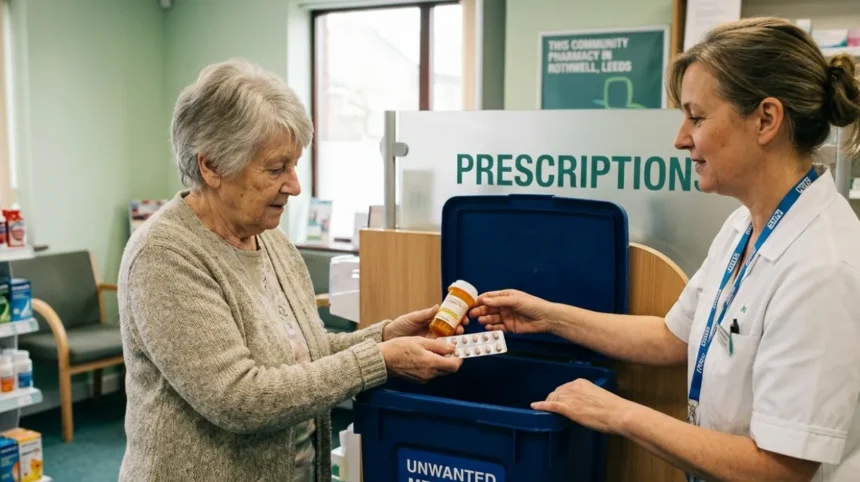
Return unwanted, expired, or surplus medicines to a local pharmacy or an authorised NHS/ local council take‑back point for safe incineration; never flush controlled drugs or dispose of large quantities or sharps at home—contact Leeds City Council or your pharmacy for specific instructions.
- What does “safe medicine disposal” mean?
- Why should Rothwell residents return medicines to pharmacies or take‑back points?
- What kinds of medicine returns do local pharmacies accept in Rothwell?
- How do I return medicines to a Rothwell pharmacy or take‑back point?
- Are there alternative disposal options if I cannot reach a pharmacy?
- What must I do with sharps and syringes used at home?
- How are returned medicines processed and destroyed?
- What are the legal and environmental implications of incorrect medicine disposal?
- How should local organisations and care homes in Rothwell manage medicine disposal?
- Where can Rothwell residents find local take‑back locations and services?
- What practical tips prevent medicine accumulation and future disposal needs?
- What should I do in an emergency if someone swallows discarded medicine?
Why this matters: safe disposal prevents accidental poisoning, drug diversion, and environmental contamination. The following guide defines terms, explains legal and practical steps, lists local routes in Rothwell, and gives data-backed reasons and procedures to follow.
What does “safe medicine disposal” mean?
Safe medicine disposal means returning medicines to authorised collectors or following government-approved household disposal methods so medicines are rendered unusable, tracked where required, and processed via licensed incineration or specialist routes to prevent harm to people and the environment.
Explanation and background: define entities and concepts. “Medicines” include prescription medicines, over‑the‑counter (OTC) products, liquid preparations, patches, and topical creams; “controlled drugs” are legally regulated substances such as morphine and methadone that require special handling and record keeping. “Authorised collectors” are pharmacies, some NHS sites, police or council-run take‑back events that accept returns for licensed disposal. Disposal routes: authorised incineration (standard for hazardous pharmaceutical waste) and regulated clinical waste services for sharps and high‑volume returns. Duty of care: businesses and healthcare providers must document medicine transfers using waste transfer notes or consignment notes and retain records for two to three years as required by UK environmental regulations.
Why should Rothwell residents return medicines to pharmacies or take‑back points?
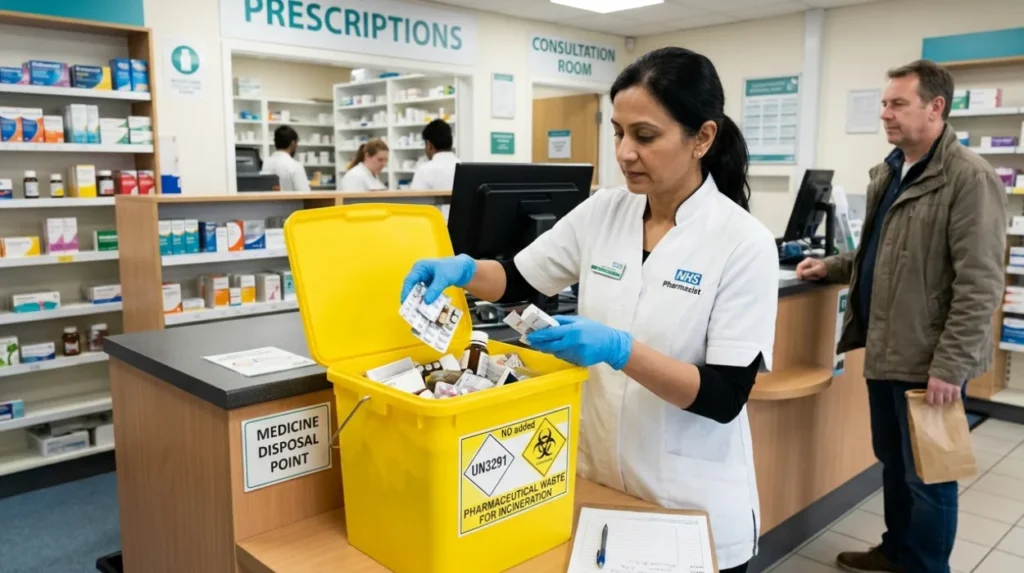
Returning medicines to pharmacies prevents accidental ingestion, reduces diversion to illegal use, and removes pharmaceutical chemicals from sewers and landfills, while ensuring regulated incineration that meets environmental and public‑health standards.
Detailed reasoning and evidence: accidental poisonings in households rise when medicines accumulate; disposing via household waste leaves drugs accessible to children or scavengers and allows leaching into soil and water, where pharmaceutical residues have been detected in UK water monitoring studies and environmental surveys. Pharmacy take‑back services are free at most UK community pharmacies and lead to secure handling of returned products; returned medicines are treated as clinical/hazardous waste and go for specialist incineration, complying with the NetRegs guidance on preventing pollution incidents.
What kinds of medicine returns do local pharmacies accept in Rothwell?
Most community pharmacies accept unwanted prescription and OTC medicines in original or any sealed containers; they accept tablets, capsules, liquids, creams, inhalers, and patches, but they require separate handling for sharps, controlled drugs, and large commercial quantities—contact the pharmacy first.
Details and categories: commonly accepted items include tablets and capsules (examples: paracetamol, amoxicillin), liquid bottles (examples: cough syrup, suspension), topical creams (examples: antifungal cream), inhalers (examples: salbutamol inhaler), and patches (examples: nicotine patches). Controlled drugs (examples: morphine, tramadol) require pharmacy staff supervision and are handled under specific legal rules; pharmacies in some areas provide secure collection boxes or supervised returns for these items. Sharps (needles, lancets) and large quantities used by businesses require clinical waste arrangements; do not place sharps in household bins—use a rigid sharps bin and follow council or NHS guidance for collection.
How do I return medicines to a Rothwell pharmacy or take‑back point?
Bring medicines in a sealed bag to any participating community pharmacy or council drop‑off during opening hours; remove personal data from packaging if possible, and follow staff instructions for handing over controlled drugs, sharps, or large volumes.
Step‑by‑step process: 1) Gather unwanted medicines in a sealed bag or container; 2) Keep liquids upright and tape lids to prevent leaks; 3) Check pharmacy opening hours—many community pharmacies in Rothwell accept returns during staffed hours; 4) Present controlled drugs directly to a pharmacist for supervised surrender; 5) For sharps, place items in a certified sharps bin before transport and inform pharmacy or council staff; 6) Do not reuse returned medicines—the pharmacy will record and dispose of them safely. Data point: most UK pharmacies offer this service free of charge as standard public health provision.
Are there alternative disposal options if I cannot reach a pharmacy?
Use council or NHS take‑back events, authorised mail‑back envelopes where available, or follow precise household disposal steps for non‑flush list medicines; never flush medicines unless the manufacturer or national authority explicitly lists them for flushing.
Alternative routes and constraints: the U.S. FDA maintains a flush list for specific high‑risk medicines when no take‑back option exists, but UK guidance prioritises pharmacy returns and cautions against flushing because of environmental risks; only follow explicit official flushing advice for specific drugs when no alternative exists. Mail‑back envelopes exist in some jurisdictions as a prepaid, secure disposal option—check with NHS pharmacy services or major retail pharmacies to confirm availability. Household disposal if no authorised option is possible: mix tablets or capsules with undesirable material (used coffee grounds, cat litter), place the mixture in a sealed container, and put the container in the household waste bin, after removing personal details from the original packaging. This method applies to most medicines not on special disposal lists.
What must I do with sharps and syringes used at home?
Place used needles and syringes in a certified sharps bin immediately; arrange collection via Leeds City Council clinical waste service or return to an authorised pharmacy or NHS sharps collection point—never place sharps loose in household waste.
Sharps procedure and legal context: a “sharps” item includes needles, syringes, lancets, and infusion sets; they are classed as clinical waste and may transmit infection if mishandled. Rothwell residents must use purpose‑designed rigid sharps containers sold by pharmacies or provided by health services; full containers are taken to pharmacy collections or booked for council collection. Businesses producing sharps require consignment notes and licensed clinical waste contractors; domestic sharps follow local NHS or council routes—contact Leeds City Council for collection bookings and fees where applicable.
How are returned medicines processed and destroyed?
Pharmacies and authorised collectors send returned medicines to licensed waste contractors for controlled incineration or specialist treatment under environmental regulations; hazardous pharmaceutical waste undergoes tracking and recordkeeping to ensure lawful destruction and pollution control.
Processing steps and regulatory framework: after collection, medicines are segregated by type—pharmaceuticals, controlled drugs, sharps, and hazardous chemical products—and stored securely pending transfer. Licensed waste carriers transport pharmaceutical waste under duty‑of‑care rules using waste transfer notes or consignment notes; hazardous and controlled drugs require specialist incineration facilities that meet air‑emission and pollution controls. NetRegs and NHS guidance require record keeping for waste transfers for two to three years and the use of licensed contractors to prevent illegal dumping or pollution incidents.
What are the legal and environmental implications of incorrect medicine disposal?
Incorrect disposal risks legal breaches under environmental regulations, potential pollution incidents, and public‑health harms, including accidental poisonings and drug diversion; businesses and healthcare providers face enforcement and fines for improper handling or disposal.
Legal specifics and environmental impact: UK regulations require waste producers and handlers to comply with the Duty of Care and use licensed waste carriers; failure to comply can prompt enforcement and penalties, and requires retention of transfer documentation. Environmental monitoring has detected pharmaceutical residues in water systems and soil, with uncertain but concerning ecological effects; specialist incineration reduces the release of active compounds compared with landfill or sewer disposal. Public‑health consequences include poisoning incidents in children and the possible reuse/diversion of medicines for non‑medical purposes when left unsecured.
How should local organisations and care homes in Rothwell manage medicine disposal?
Organisations and care homes must use authorised clinical waste contractors, keep full records using waste transfer or consignment notes, segregate controlled drugs with proper registers, and arrange incineration or hazardous waste treatment under environmental law.
Operational steps and compliance: employers and care providers must store medicines securely in locked areas, maintain a register for controlled drugs with signature records, separate hazardous or cytotoxic drugs for specialist disposal, and use licensed waste carriers for removal; retain waste transfer and consignment notes for statutory retention periods of two to three years. Care homes should coordinate with NHS pharmacy services for returns and follow local public‑health directives on vaccination or pandemic‑related pharmaceutical waste.
Where can Rothwell residents find local take‑back locations and services?
Search NHS resources, contact your local community pharmacy, or consult Leeds City Council waste services to locate pharmacy take‑back points, scheduled drug take‑back events, and clinical waste collections available to Rothwell residents.
Local sourcing and contact points: community pharmacies form the primary, accessible network for medicine returns in Rothwell; NHS England and Integrated Care Boards publicise local pharmacy services and take‑back events, and Leeds City Council lists household clinical waste collection services, including sharps disposals and booking procedures—call or check official council pages for current opening times and event dates. Example: many West Yorkshire pharmacies advertise free medicine disposal services and will accept standard household quantities without charge.
What practical tips prevent medicine accumulation and future disposal needs?
Order only prescribed quantities, use repeat prescription reviews, store medicines in labelled containers with expiry dates, dispose of single‑course leftovers promptly at pharmacies, and review household supplies quarterly to avoid stockpiling.
Practical actions and data: NHS and pharmacy guidance recommends checking medication lists with prescribers before repeat ordering and returning unused supplies immediately to pharmacies to reduce waste. Studies and pharmacy campaigns note that unnecessary ordering and stockpiling increase waste volumes and risk of misuse; routine medication reviews lower unused supply rates and associated disposal needs.
What should I do in an emergency if someone swallows discarded medicine?
Call NHS 111 immediately for non‑life‑threatening poisoning guidance, or call 999 for severe symptoms; keep the medicine container for identification and follow emergency services instructions on first aid and transport to hospital.
Emergency steps and data: provide exact medicine names, amounts, and time of ingestion to NHS 111 or emergency responders; several UK poison‑control resources exist through NHS and local emergency care services. Retaining the medicine packaging permits accurate identification and appropriate clinical treatment.
What is the safest way to dispose of old medicines in Rothwell?
The safest way to dispose of old medicines in Rothwell is to return them to a local pharmacy or authorised NHS take-back point for regulated disposal and incineration. Medicines should never be flushed down toilets or thrown loosely into household bins because this can cause environmental contamination and accidental poisoning.