Key Points
- Leeds City Council has locked one of the pedestrian access gates at Yeadon Cemetery in response to escalating anti-social behaviour.
- Reported incidents at the grounds include public urination, littering, and intimidating behaviour towards passers-by.
- West Yorkshire Police previously increased patrols around the Cemetery Road location following reports of groups of vehicles waiting outside for extended periods.
- Signs posted at the location inform the public that the gate closure is intended to preserve a peaceful and respectful environment.
- The local authority confirmed that the site remains open to visitors through its main entrance while the impact of the temporary closure is monitored.
- Members of the public who observe anti-social activity are being urged to report incidents directly to the police.
Yeadon Leeds (The Leeds Times) August 27, 2026 – Access to a prominent cemetery in West Yorkshire has been formally restricted following persistent reports of anti-social behaviour occurring within the grounds and along its immediate perimeter. Leeds City Council confirmed that action has been taken at Yeadon Cemetery, located on Cemetery Road, after recurring incidents compromised the site’s environment. The local authority has locked one of the pedestrian access gates to curb illicit activities, which have included public urination, littering, and loitering by groups of vehicles. Although one access point has been secured, municipal officials clarified that the cemetery remains accessible to members of the public via the primary entrance point while local authorities monitor the effectiveness of the measure over the coming months.
What Incidents Led to the Restrictive Measures at Yeadon Cemetery?
The decision to restrict access follows a series of disruptions reported by residents and visitors near the site, which sits in close proximity to Leeds Bradford Airport. Over the course of the past year, concerns escalated regarding anti-social conduct both within the burial grounds and along the adjacent highway.
Police officers from West Yorkshire Police were previously required to step up visible patrols along Cemetery Road. This police intervention was initiated after reports highlighted groups of vehicles remaining stationary outside the site for long periods, accompanied by allegations of intimidating behaviour directed towards pedestrians and local residents.
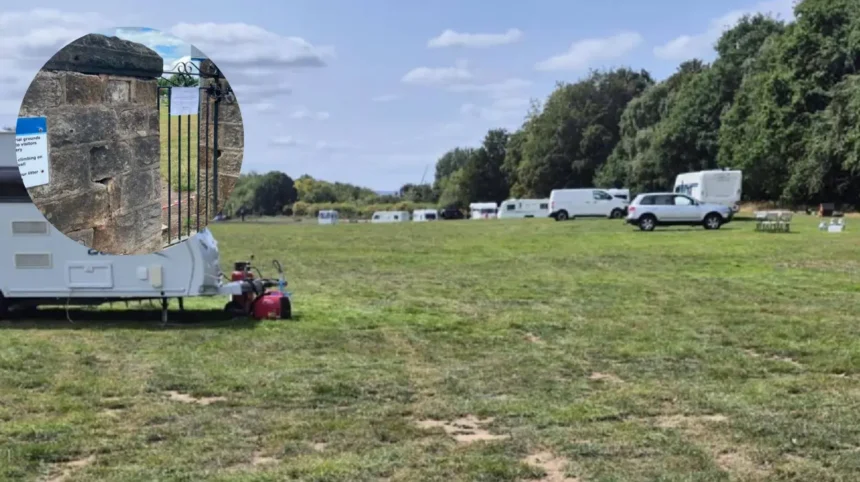
Visitors to the site recently noted physical changes to the infrastructure. A formal sign attached directly to the locked pedestrian gate outlines the rationale behind the closure:
“Due to incidents of anti-social behaviour, and in order to preserve the peaceful and respectful atmosphere of the cemetery, this gate has been locked. We apologise for any inconvenience this may cause and thank you for your understanding and cooperation.”
In an official statement addressing the operational change, a spokesperson for Leeds City Council outlined the steps taken by the local authority:
“We are aware of concerns raised about the use of Yeadon Cemetery by some visitors. As a temporary measure, one of the pedestrian access gates has been locked and we will monitor the impact of this over the coming months. The cemetery remains open and accessible through its main entrance.”
Following these developments, members of the public who witness or experience anti-social behaviour in or around the cemetery grounds are being encouraged to report all details directly to West Yorkshire Police to assist ongoing monitoring efforts.
Explore More Leeds City Council News
Leeds Council Plans 25 Affordable Apartments in Farsley 2026
Leeds Submits Planning for 25 Farsley Council Homes, Farsley 2026
Background of the Development
Yeadon Cemetery serves the local community in North West Leeds as a municipal burial site. Due to its geographic location adjacent to major transport infrastructure—specifically Leeds Bradford Airport—the surrounding roadways frequently experience varying volumes of traffic, static vehicles, and visitors taking advantage of the elevated vantage points around the perimeter.
Over recent years, public space management across municipal sites in Leeds has faced heightened scrutiny regarding anti-social behaviour, vehicle loitering, and environmental maintenance.
Under the Crime and Disorder Act 1998, local authorities and police forces maintain joint statutory responsibilities to implement measures that reduce crime and disorder within public amenities.
Physical security adaptations—such as selective gate closures, perimeter fencing alterations, and targeted access control—represent standard initial interventions utilized by municipal councils across the United Kingdom to disrupt unwanted gathering patterns without requiring full site closures or high-cost security infrastructure.
The temporary locking of pedestrian gates at Yeadon Cemetery follows similar measures deployed in urban and suburban parks across West Yorkshire where selective access management has been used to mitigate night-time loitering and illegal deposit of waste.
How Will This Access Restriction Affect Cemetery Visitors and the Local Community?
The implementation of restricted access at Yeadon Cemetery is anticipated to impact several distinct groups within the local community in direct and indirect ways:
- Bereaved Families and Regular Visitors: Individuals visiting graves will experience minor operational disruptions. While the site remains open, the closure of a secondary pedestrian gate necessitates longer walking routes for visitors approaching from specific residential streets or parking spots along the secondary perimeter. However, regular visitors are expected to experience an improved, more tranquil environment within the grounds if the measures successfully deter public urination and intimidation.
- Local Residents along Cemetery Road: Residents living in the immediate vicinity of the cemetery may see a reduction in street-level disturbances, noise pollution, and vehicle loitering outside their properties. Conversely, restricting one entry point could temporarily shift static vehicle parking or loitering to alternative nearby residential streets if driver behaviour is not fully curbed by police monitoring.
- West Yorkshire Police and Council Operations: For law enforcement and municipal officers, the closure serves as a passive deterrent designed to reduce the volume of call-outs to the area. The coming months of monitoring will determine whether physical access restrictions reduce the need for active police patrols or if further enforcement measures, such as Public Spaces Protection Orders (PSPOs), will be required.