

Horsforth is one of the most historically distinctive areas of Leeds. Its heritage stretches from Anglo-Saxon settlement and the Domesday period to medieval monastic landholding, Georgian architecture, Victorian religious development, industrial growth and railway expansion.
- What makes Horsforth historically important?
- Where should history enthusiasts start in Horsforth?
- Which parts of Town Street are best for historic architecture?
- What can visitors see at Horsforth Hall Park?
- Why is St Margaret’s Church important to Horsforth history?
- How does Horsforth railway history explain the area’s development?
- Which historic houses and buildings should visitors look for?
- What historic sites near Horsforth should history enthusiasts add?
- How can history enthusiasts explore Horsforth in one day?
- What is the best way to understand Horsforth’s heritage today?
- Why should history enthusiasts visit Horsforth?
The strongest concentration of historic interest sits around The Green, Town Street, Hall Park and Station Road. These areas preserve buildings, landscapes and street patterns that explain how Horsforth developed from a rural settlement into a substantial Leeds suburb.
Leeds City Council identifies Horsforth as a historic settlement with links reaching into the Anglo-Saxon period. The Horsforth Conservation Area was initially designated in 1973 and modified in 1975 because of the area’s historic character and surviving architectural fabric.
For visitors interested in history, Horsforth works particularly well as a walking destination. Its heritage is not concentrated inside one large attraction. Instead, it appears across a museum, churches, listed buildings, former farms, a historic village green, a country-house landscape and railway sites.
What makes Horsforth historically important?
Horsforth combines an Anglo-Saxon place-name, Domesday history, medieval monastic connections, Georgian stone buildings, Victorian institutions, railway heritage and twentieth-century community life. Its historic core around The Green and Town Street provides a concentration of places for history-focused visitors to explore.
The name Horsforth derives from Old English words associated with a horse ford. The exact location of the original ford is not known because the landscape around the valley has changed substantially.
The first known written reference to Horsforth appears in the Domesday Survey of 1086, compiled after the Norman Conquest. The Leeds City Council conservation appraisal records Horsforth as being valued at 30 shillings in Domesday. The settlement was therefore already recognised as an economic holding in the late eleventh century.
The medieval period introduced another major influence. Kirkstall Abbey, founded in 1152 by Cistercian monks, acquired land in the surrounding area. Parts of northern Horsforth became associated with a monastic grange, or agricultural estate, which connected local farming with the economic system of the abbey.
The Dissolution of the Monasteries transformed this relationship. Henry VIII’s agents closed Kirkstall Abbey in 1539, and its lands were subsequently transferred into private ownership. This change helped reshape landholding in Horsforth and influenced the development of prominent local families, including the Stanhopes.
By the eighteenth and nineteenth centuries, Horsforth had developed a stronger village economy. Agriculture remained important, while weaving, mills, building trades, education, transport and local institutions expanded.
The result is a layered historic environment. A visitor walking only a short distance can encounter medieval place-name evidence, eighteenth-century cottages, nineteenth-century religious architecture and railway heritage.
Where should history enthusiasts start in Horsforth?
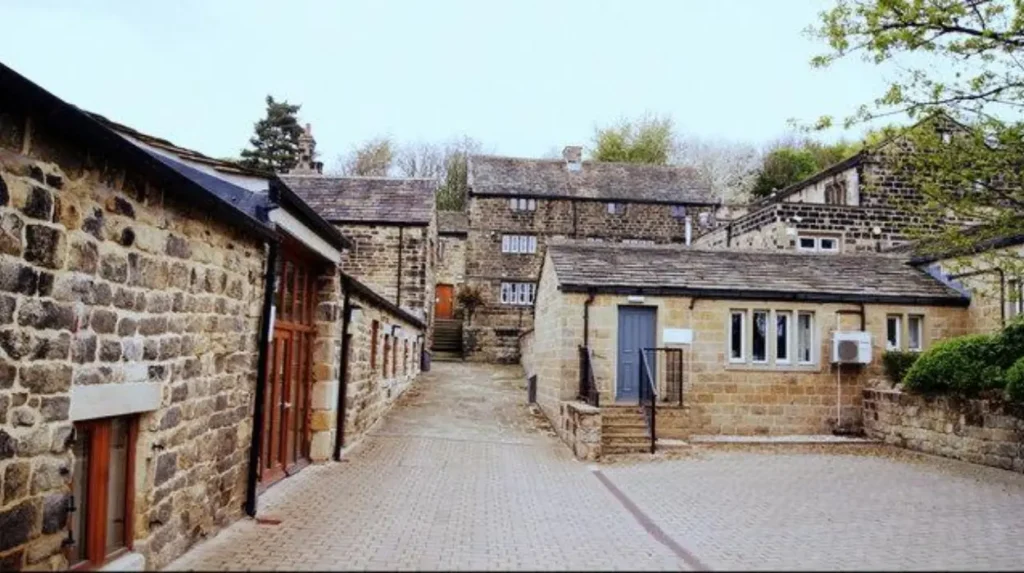
Horsforth Village Museum is the best starting point for understanding local history because its collections connect buildings, families, work, transport, education and wartime experiences. Opened in 1988, the volunteer-run museum occupies former council chambers beside The Green for visitors.
Horsforth Village Museum is located at 5 The Green, Horsforth. The museum opened in 1988 and is run entirely by volunteers. Its stated purpose is to preserve and interpret the history of Horsforth through objects and exhibitions covering life in and around the village.
The museum is particularly valuable because Horsforth’s history is largely a local community history rather than the story of one major royal or military event.
Collections and displays cover everyday life. These include work, domestic life, transport, education, local organisations and community development. This approach gives visitors a more detailed understanding of how residents experienced historical change.
The museum’s position on The Green is also significant. The Green forms part of the historic village core. Historic research into Horsforth identifies this area and the southern end of Town Street as important surviving evidence of the medieval settlement pattern.
Visitors should allow time to examine the museum before beginning a walking tour. The museum provides context for buildings that can otherwise appear simply as attractive stone properties.
Opening arrangements are seasonal and should be checked before travelling. Visit Leeds currently lists Saturday and Sunday opening during the main museum season, while the museum’s own information is updated through its local channels.
For history-focused visitors, the museum also provides a useful starting point for understanding the difference between national heritage and local heritage. A listed building protects architectural significance, while a community museum can preserve photographs, documents, objects and memories that explain how residents used those places.
Which parts of Town Street are best for historic architecture?
Town Street is Horsforth’s historic architectural spine, with surviving eighteenth-century sandstone cottages, former farm buildings and later civic structures. Walking this route reveals how an agricultural settlement developed into an urban community while retaining a distinctive village-scale streetscape today.
Town Street is the central historic street of Horsforth. Leeds City Council describes it as the historic heart of the area and identifies its long, gently meandering form as a defining feature. Many buildings stand close to the pavement, creating a strong sense of enclosure.
The street contains several listed buildings that demonstrate the evolution of Horsforth’s domestic architecture.
At 79, 81 and 83 Town Street, a Grade II listed row of cottages dates from the later eighteenth century. The buildings use coursed squared sandstone and stone slate roofing. Their form reflects the domestic architecture associated with the period.
Further along Town Street, 123–135 Town Street forms another important group. Historic England records the buildings as an eighteenth-century row of cottages created through the remodelling of a farmhouse and associated outbuildings. No. 129 forms part of the former farmhouse at the centre of the group.
Croft House, at No. 155 Town Street, is another Grade II listed building. Historic England dates its principal fabric to the mid-to-late eighteenth century, with later enlargement and alteration. Its sandstone construction and architectural details contribute to the historic streetscape.
The importance of Town Street is therefore not based on one landmark. It comes from the cumulative survival of historic buildings.
Look closely at roof materials, window proportions, stonework, door surrounds, building alignment and changes in scale. These details reveal different phases of development.
The surrounding Long Row area also contains listed eighteenth-century sandstone buildings. Historic England records Nos. 2, 6 and 8 Long Row as Grade II listed structures.
As you explore the modern street, you are crossing land shaped by centuries of settlement. Read about the full to understand its origins.
Town Street is particularly suitable for a self-guided heritage walk because its architecture remains integrated into the functioning neighbourhood rather than isolated inside a museum.
What can visitors see at Horsforth Hall Park?
Horsforth Hall Park preserves the setting of a former country house and contains the surviving Grade II listed stable block. The park also includes a war memorial and recreational features, making it useful for studying changing land use and community memory.
Horsforth Hall Park occupies land associated with the former Horsforth Hall.
The hall itself has disappeared, but its historic landscape survives through the park and associated buildings. Leeds City Council identifies Horsforth Hall Park as the area’s largest green space and records the surviving stable block as an important historic structure.
The Stable Block to Former Horsforth Hall is Grade II listed. Historic England dates the building principally to the later eighteenth century while noting a datestone marked 1707. It is constructed from coursed squared sandstone with a stone slate roof.
This makes the stable block particularly valuable for understanding the estate system of historic Horsforth. Country houses depended on extensive service buildings, agricultural facilities, storage areas, stables and domestic staff.
The park also contains a war memorial, cricket facilities, a bowling green and a bandstand. These features demonstrate how the former private landscape evolved into a public recreational space.
This transition is historically significant. It reflects the wider transformation of English towns during the nineteenth and twentieth centuries, when estates and private land increasingly became incorporated into public urban life.
The park therefore has two historical dimensions.
The first is estate history, represented by the former hall and surviving stable block.
The second is community history, represented by the memorial and recreational facilities.
A visit to Hall Park works particularly well after exploring Town Street because the two locations demonstrate different aspects of Horsforth’s development.
Why is St Margaret’s Church important to Horsforth history?
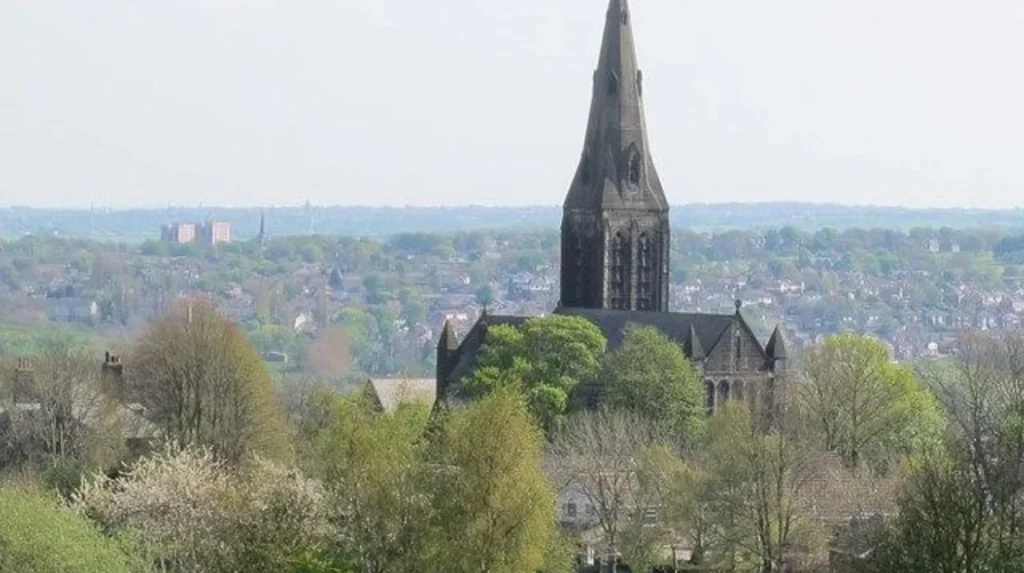
St Margaret’s Church records Horsforth’s Victorian expansion and changing religious needs. Designed by J. L. Pearson and built between 1877 and 1883, the Grade II listed church replaced an earlier chapel that had become too small for the growing congregation.
St Margaret’s Church stands on Church Lane.
The church is a Grade II listed building. Historic England records its construction between 1877 and 1883, with the design attributed to architect J. L. Pearson. Its spire was completed in 1902 by J. B. Frazer.
The church was built in response to population growth. Historic England’s research into Pearson’s church interiors states that the building replaced an eighteenth-century chapel known as the Bell Chapel, which had become too small for the expanding congregation.
This makes St Margaret’s important beyond its architectural appearance.
It represents the relationship between population growth and Victorian church building. As Horsforth expanded, existing religious buildings no longer provided sufficient accommodation. A larger church was therefore constructed in a prominent position.
The architecture follows the Early English Gothic style. Features include lancet windows, a substantial nave, aisles, transepts, a chancel and a south-east tower.
The building also illustrates the work of J. L. Pearson, one of the major Victorian Gothic Revival architects.
History enthusiasts should examine the relationship between the church and its surrounding streets. The church stands within an area that developed significantly during the nineteenth and twentieth centuries.
The churchyard also forms part of Horsforth’s heritage landscape. Leeds City Council identifies the St Margaret’s Church graveyard within its parks and open-space records.
St Margaret’s therefore provides evidence of religious, architectural and demographic history in one location.
How does Horsforth railway history explain the area’s development?
Station House and Horsforth railway station explain how nineteenth-century transport transformed the settlement. The station opened in 1849 on the Leeds and Harrogate line, while the surviving historic farmhouse nearby was later used as the station master’s house there.
Railway development changed Horsforth’s relationship with Leeds and the wider region.
Horsforth railway station opened in 1849 on the Leeds to Harrogate railway line. Historic England records the importance of the station to the area’s transport history.
The nearby Station House provides an unusual link between agricultural and railway history.
The building originated as a farmhouse. Historic England dates the attached barn to the late seventeenth century, the house to the early-to-mid eighteenth century and the cottage to the mid-to-late eighteenth century. It was subsequently used as the station master’s house.
Historic England also records that the first floor of the house was reportedly used as a weaving workshop. This detail connects domestic architecture with the local textile economy.
The railway station itself underwent substantial change during the twentieth century. The original station buildings were demolished in 1969 during a period of railway rationalisation in West Yorkshire. New waiting rooms and a ticket office were constructed in 2002–2003.
This makes the station area useful for understanding transport continuity and change.
The railway did not simply provide a new way to travel. It affected employment, commuting, trade, land values and the physical expansion of settlements.
For modern visitors, the railway also makes Horsforth’s historic core relatively accessible from other parts of Leeds and West Yorkshire.
The surviving Station House is especially important because it demonstrates that railway heritage is not limited to platforms and railway lines. Railway development often reused existing buildings and incorporated them into new transport infrastructure.
Which historic houses and buildings should visitors look for?
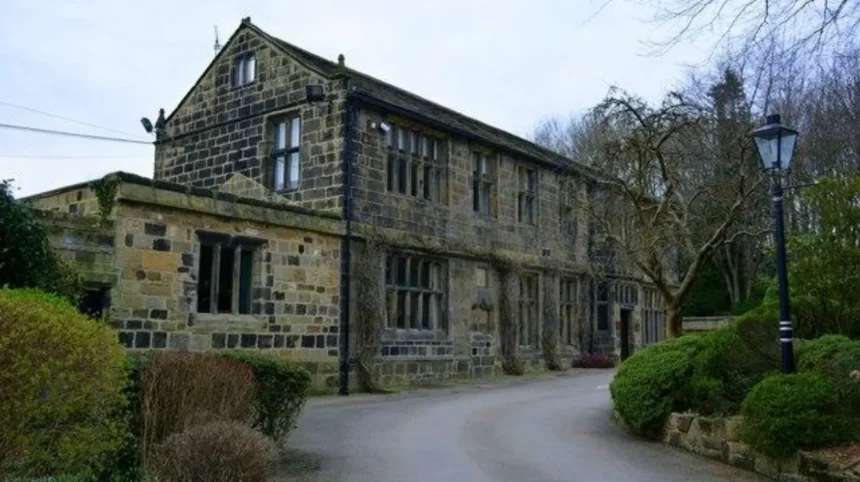
Low Hall and nearby historic properties preserve evidence of Horsforth’s earlier landholding families, farming economy and sandstone domestic architecture. Low Hall is a Grade II listed manor house and farmhouse, with fabric dating from the sixteenth to seventeenth centuries today.
Low Hall is one of Horsforth’s most important surviving historic houses.
Historic England lists Low Hall as Grade II. The building is described as a manor house and farmhouse, with parts dating from the mid-to-late sixteenth century and substantial later seventeenth-century fabric. It was associated with the Stanhope family.
Its importance comes from the way it combines several historical functions.
A manor house represented local landholding authority. A farmhouse connected that authority with agricultural production. Later alterations demonstrate how buildings changed as families, economies and social expectations evolved.
The building therefore provides an architectural record of changing rural society.
Other historic properties around Horsforth add to this picture.
Town Street contains eighteenth-century cottages and former farm structures. Long Row includes additional listed sandstone buildings. Hall Lane also retains historic structures associated with the former Horsforth Hall estate.
These buildings should be viewed as part of a historic network rather than isolated monuments.
Sandstone is particularly important. Local stone became a defining construction material across the historic core, producing a consistent visual character.
Historic England’s listing records provide another useful research tool. A listed building is included on the National Heritage List for England because of special architectural or historic interest. Listing provides statutory protection under the Planning (Listed Buildings and Conservation Areas) Act 1990, subject to the legislation and individual designation.
Visitors should remember that listed status does not automatically mean a building is open to the public. Many listed properties remain private or have modern uses.
For this reason, external architectural observation is often the appropriate way to appreciate Horsforth’s historic houses.
What historic sites near Horsforth should history enthusiasts add?
Kirkstall Abbey and Abbey House Museum lie just beyond Horsforth but provide essential context for its medieval and post-medieval development. The abbey was founded in 1152, while Abbey House became a museum in 1927 and documents Leeds social history nearby.
Kirkstall Abbey is one of the most important historic sites close to Horsforth.
Cistercian monks began building the abbey in 1152 on land associated with Henry de Lacy, Baron of Pontefract. The community remained at Kirkstall until the Dissolution of the Monasteries. Abbot John Ripley surrendered the abbey to Henry VIII’s agents on 22 November 1539.
Kirkstall Abbey is essential to understanding Horsforth because its medieval landholding extended into the surrounding area. The Horsforth conservation appraisal identifies a monastic farm or grange on the northern edge of the township.
The abbey therefore connects Horsforth’s local landscape with a much larger medieval economic system.
Nearby Abbey House Museum adds another historical layer.
The building began as the inner gatehouse of Kirkstall Abbey. After the Dissolution, it became a house during the sixteenth century. Abbey House opened as a museum in 1927.
The museum now focuses heavily on social history. Its collections include toys, household objects, tools, retailing material, musical instruments, slot machines, automata and printed ephemera. Leeds Museums and Galleries records more than 100,000 items within its wider social-history collections.
This combination creates a strong heritage itinerary:
Start at Horsforth Village Museum to understand local community history.
Walk through The Green and Town Street to examine historic buildings.
Continue towards Hall Park and the surviving stable block.
Visit St Margaret’s Church for Victorian religious and architectural history.
Explore Station Road and the railway area for nineteenth-century transport history.
Finish with Kirkstall Abbey and Abbey House Museum for medieval and wider Leeds context.
The route demonstrates how Horsforth’s history connects with the development of the wider Leeds urban area.
How can history enthusiasts explore Horsforth in one day?
A one-day Horsforth heritage itinerary should begin at The Green, continue along Town Street, include Hall Park and St Margaret’s Church, then explore Station Road before extending the visit towards Kirkstall Abbey and Abbey House Museum.
A practical walking programme starts at The Green, where Horsforth Village Museum provides an introduction to the settlement.
After the museum, walk along Town Street. Focus on the sandstone buildings and the surviving eighteenth-century architectural groups. The route demonstrates how agricultural and domestic buildings gradually became part of a modern commercial centre.
Continue towards Horsforth Hall Park. Examine the surviving stable block and consider how the former estate landscape became a public park. The war memorial provides a separate connection with twentieth-century community history.
Next, continue towards St Margaret’s Church. The building represents Victorian Horsforth and the consequences of population growth. Its architecture provides a clear example of the Gothic Revival period.
The next stage is Station Road and Horsforth railway station. Compare the surviving Station House with the modern railway infrastructure. This is one of the clearest places to observe how historic buildings and modern transport systems coexist.
A longer itinerary should then continue towards Kirkstall Abbey.
The abbey provides the medieval context that explains why Horsforth’s history cannot be studied entirely in isolation. Its former landholding system influenced the surrounding landscape.
Finish at Abbey House Museum if opening arrangements allow. Its social-history collections extend the story beyond medieval religion into domestic, commercial and community life.
The full itinerary covers several chronological periods without requiring a specialist archaeological background.
What is the best way to understand Horsforth’s heritage today?
The most effective approach is to combine museum research with a heritage walk. Horsforth’s history is distributed across The Green, Town Street, Hall Park, St Margaret’s Church, Station Road and surrounding sites rather than concentrated within one attraction.
Horsforth’s historic value comes from continuity.
The Domesday settlement is no longer a medieval village in physical form. The medieval monastic economy has disappeared. The former Horsforth Hall has been demolished. The original railway buildings were removed in 1969.
Yet substantial evidence remains.
The Green preserves the location and character of the historic village centre. Town Street retains eighteenth-century buildings. Low Hall records earlier estate history. The stable block survives from the Horsforth Hall landscape. St Margaret’s Church documents Victorian expansion. Station House preserves an earlier farmhouse adapted to railway use.
Leeds City Council’s planning documents recognise this layered character. The Horsforth neighbourhood plan identifies separate character areas including Town Street, Low Lane and Troy, Broadgate, Cragg Hill and Woodside, and Newlay and New Road Side. It also identifies Victorian industrial heritage around Low Lane and the railway.
This makes Horsforth particularly useful for visitors interested in urban historical geography.
Urban historical geography examines how settlements change over time and how buildings, roads, industries, transport systems and public spaces reflect those changes.
Horsforth provides a compact example.
Its early settlement pattern developed around the village green. Agricultural landholding shaped later estates. Monastic ownership connected the area with Kirkstall Abbey. Private landownership expanded after the Dissolution. Eighteenth-century stone buildings reflect economic and architectural development. Victorian institutions demonstrate population growth. Railway infrastructure connected the settlement more closely with Leeds and surrounding towns. Twentieth-century public spaces demonstrate changing patterns of recreation and remembrance.
The modern suburb therefore contains physical evidence from several historical periods.
For history enthusiasts, that is the central attraction of Horsforth.
Explore More Area Guide
Horsforth Green Corridors and Open Areas Guide 2026
Horsforth Places for an Unplanned Day Out | Leeds 2026
Why should history enthusiasts visit Horsforth?
Horsforth offers a dense collection of accessible heritage evidence without requiring a long journey between widely separated destinations. Its strongest historic assets include Horsforth Village Museum, The Green, Town Street, Horsforth Hall Park, the former Hall stable block, St Margaret’s Church, Low Hall and Station House.
The area also provides a direct connection to Kirkstall Abbey, whose medieval history is fundamental to understanding Horsforth’s development.
Its heritage is architectural, social, religious, agricultural, industrial and transport-related. The evidence ranges from the 1086 Domesday Survey to the nineteenth-century railway and twentieth-century public spaces.
For visitors interested in local history, Horsforth demonstrates how a settlement can preserve its historical identity while becoming part of a major modern city.
The best approach is to slow down and examine the physical environment. Stone cottages, building alignments, old farm structures, church architecture, estate buildings and railway infrastructure all provide historical information.
Horsforth is therefore not simply a place with several old buildings. It is a connected historic landscape in which each site explains another part of the area’s development.
What is the most historic place to visit in Horsforth?
Horsforth Village Museum is an excellent starting point for exploring local history. It explains Horsforth’s development through collections covering community life, work, transport, education and local heritage.