Key Points
- Major civic buildings across the United Kingdom, including Leeds Town Hall and landmarks in London, are being illuminated in red and scarlet lights this week.
- The illumination marks and celebrates the major Hindu festival of Durga Puja.
- Durga Puja is traditionally observed for 10 days during the Hindu calendar month of Ashvina, which typically falls between September and October.
- The festival commemorates the victory of the goddess Durga over the demon king Mahishasura.
- In 2026, the principal rituals of Durga Puja commenced with Shashthi on Friday, 16 October, and concluded with Vijayadashami, which ran from Tuesday, 20 October, to Wednesday, 21 October.
- Cultural traditions concluding the festival include Bijoya Dashami rituals, Sindoor Khela, the exchange of family greetings, and the immersion of idols.
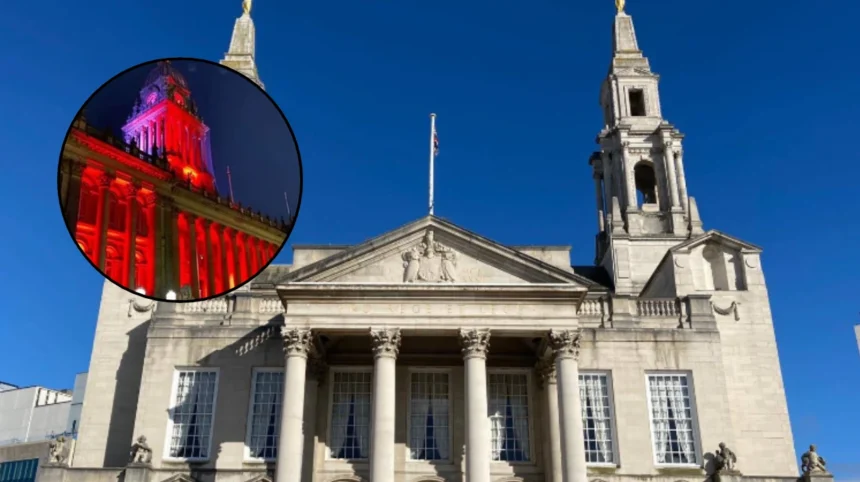
LEEDS (The Leeds Times) October 22, 2026 — Prominent civic landmarks and cultural sites across the United Kingdom have been illuminated in striking red and scarlet hues this week as local authorities and communities join in celebrating Durga Puja, one of the most significant annual festivals in Hinduism.Leeds City Council announced on Wednesday that several major structures within the northern city centre, including the historic Leeds Town Hall, would alter their external lighting schemes to scarlet. Council representatives stated that the public display was organised specifically to recognise and honour the Hindu observance, which is widely celebrated across the global diaspora and particularly within British-Asian communities. In addition to the official civic light displays in West Yorkshire, capital landmarks and civic spaces in London also hosted public gatherings, cultural showcases, and light displays on Wednesday to mark the festival period.
What Is Durga Puja and Why Is It Celebrated?
Durga Puja is a major ten-day festival within Hinduism that is traditionally held during the month of Ashvina, the seventh month of the Hindu calendar, which corresponds to the late September and October period in the Gregorian calendar. The festival holds significant cultural and religious importance in eastern Indian states—notably West Bengal and Assam—as well as across Bangladesh and worldwide diaspora communities in the United Kingdom.
As detailed in entries from Encyclopaedia Britannica, Durga Puja celebrates the victory of the deity Durga over the demon king Mahishasura.
According to Hindu tradition and mythology, the central gods combined their divine energies to create goddess Durga in order to defeat Mahishasura, who had acquired power that rendered him nearly invincible. The festival period officially begins on the same day as Navratri, a nine-night festival observed across northern and western regions that broadly honours the divine feminine energy, known as shakti.
When Do the Specific Rituals Take Place?
The timeline of Durga Puja spans ten days, with the most intense period of public and private ritual worship beginning on the sixth day. For the 2026 calendar year, the primary ritual observances commenced with Shashthi on Friday, 16 October 2026.
The celebrations culminated with the observance of Vijayadashami, which began on Tuesday, 20 October 2026, and extended through to Wednesday, 21 October 2026. The final day, also referred to as Bijoya Dashami, marks the conclusion of the traditional Bengali Durga Puja festivities, serving as the official period when devotees bid farewell to the goddess prior to the ceremonial immersion processions.
How Are the Concluding Rituals Observed in British Communities?
During Bijoya Dashami, families and community groups observe several traditional customs that combine solemn farewells with joyful social gatherings. A central tradition among married women in many Bengali communities is Sindoor Khela, a ritual that involves applying red vermilion powder to the idols of the goddess and subsequently to one another.
Following these sacred rituals, families and local community members exchange traditional sweets, physical gifts, and seasonal greetings.
The final day represents a distinct mix of celebration and farewell, as practitioners say goodbye to the goddess while anticipating her symbolic return in the following year. Public immersion ceremonies, where crafted statues of Durga are brought to designated bodies of water, traditionally conclude the ten-day period.
Explore More Leeds City Council
Leeds City Council Granted £1.6m Grant for Rough Sleeping, Leeds 2026
Leeds Council Confirms Bonfire Night Celebrations Decision: Leeds 2026
Background of the Particular Development
The practice of lighting public buildings and civic landmarks in distinct colours to mark national, international, and religious events has become a widespread convention among UK local authorities in recent years. Civic buildings such as Leeds Town Hall, built between 1853 and 1858, frequently serve as central focal points for community recognition, heritage celebrations, and public awareness campaigns.
In the United Kingdom, local councils and municipal authorities regularly coordinate lighting initiatives to reflect the cultural diversity of their resident populations.
Cities with significant multicultural communities, including Leeds and London, utilize public spaces and municipal assets to acknowledge major cultural and religious milestones, including Diwali, Eid, Hanukkah, Christmas, and Durga Puja. These official illuminations are designed to demonstrate civic inclusion and showcase local heritage within public urban centers.
Prediction: How This Development Can Affect the Particular Audience
The decision by local councils to light up civic buildings in red for Durga Puja is expected to have several distinct impacts on local communities, civic institutions, and the wider public across the United Kingdom.
For the British-Hindu and Bengali diaspora communities, the prominent red light displays at major sites like Leeds Town Hall provide official civic recognition of their heritage and religious traditions. This visibility is likely to foster a stronger sense of local belonging and strengthen ties between diaspora organizations and local government bodies.
For the broader non-Hindu public and city residents, large-scale public illuminations serve as an educational catalyst. By drawing public attention to the festival through high-profile urban lighting, the initiative encourages greater awareness of the Hindu calendar, traditional observances like Navratri and Bijoya Dashami, and the multicultural history present within modern British cities.
From a municipal policy perspective, the positive reception of major cultural light displays is predicted to encourage other local councils across the UK to adopt similar public lighting schedules for a wider variety of ethnic and religious celebrations. This trend will likely lead to formalised municipal calendars for civic lighting, turning heritage landmarks into regular canvases for community inclusion.