Garforth is a town in east Leeds with a strong pub tradition shaped by turnpike travel, agriculture, mining and local community life. Its drinking establishments range from historic coaching-inn sites to modern pubs operating from buildings with strong connections to Garforth’s past.
- What makes Garforth’s pubs and traditional inns distinctive?
- Which Garforth pubs have the strongest historical connections?
- Where can visitors find Garforth’s main pub areas?
- What is the history of the Gaping Goose in Garforth?
- Why is the Miners’ Arms important to Garforth’s industrial heritage?
- What can visitors expect at The Briggate in Garforth?
- Which Garforth pubs are best for understanding local community life?
- How does Garforth’s mining history influence its pub names?
- What should visitors look for inside a traditional Yorkshire pub?
- How did coaching inns shape Garforth’s pub tradition?
- How can visitors explore Garforth’s pubs responsibly?
- How can a pub visit be combined with Garforth’s wider heritage?
- Why does Garforth’s traditional pub heritage remain relevant today?
- What is the best way to plan a Garforth pub and heritage visit?
The town’s heritage is particularly visible around Main Street, Aberford Road and Selby Road. Leeds City Council’s Garforth Neighbourhood Plan identifies several historic public houses and former inns as important local heritage assets. The plan records the Old George, Gaping Goose, Miners’ Arms and Lord Gascoigne among the town’s notable historic buildings.
A pub visit in Garforth therefore provides more than food and drink. It gives visitors a practical way to understand the settlement’s transport history, industrial development, architecture and community identity.
As you explore the modern pub scene, you are crossing land with a deep heritage. Read about the full to understand its origins.
What makes Garforth’s pubs and traditional inns distinctive?
Garforth’s pubs combine traditional Yorkshire pub culture with buildings and locations connected to coaching routes, mining, local estates and community institutions. Historic examples include the Gaping Goose, Miners’ Arms, Lord Gascoigne and the former Old George site.
Garforth’s pub heritage developed alongside the town itself. The settlement occupies an important position east of Leeds, close to historic routes towards Selby, Aberford and other parts of West Yorkshire.
A public house traditionally served several functions. It provided accommodation, food, drink, stabling and meeting space. Coaching inns were particularly important before modern rail and road transport transformed local travel.
Garforth retains evidence of this earlier system. Leeds City Council records the Gaping Goose as a public house known to have been operating by 1822. The council identifies it as the oldest pub in Garforth and links its development to travellers using the former turnpike road towards Selby.
The Miners’ Arms represents a different part of the town’s history. Its earlier names included the Black Bull and Jolly Collier, while its later identity connects directly with Garforth’s mining heritage.
This mixture of transport and industrial history gives Garforth’s pub landscape a clear local identity.
Which Garforth pubs have the strongest historical connections?
The Gaping Goose, Miners’ Arms, Lord Gascoigne and Old George have particularly strong historical associations. Their stories connect Garforth with turnpike travel, coal mining, the Gascoigne family, coaching and the town’s nineteenth-century development.
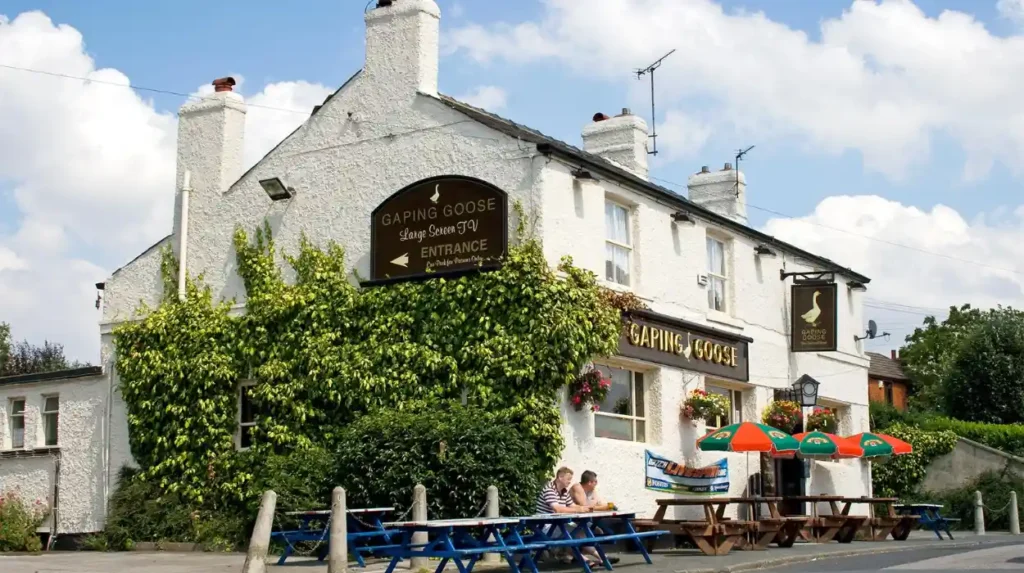
The Gaping Goose stands on Selby Road. Leeds City Council states that it was operating by 1822 and served travellers using the former turnpike road to Selby. The building was remodelled in 1930 but retained older features.
The pub’s unusual name also has a documented local explanation. The council records that it was originally called the White Swan. A badly painted sign reportedly led to the name Gaping Goose becoming established.
The Miners’ Arms on Aberford Road provides a direct link to Garforth’s mining past. The building has a blue plaque commemorating Sergeant Albert Mountain, a former publican who received the Victoria Cross and Military Medal during the First World War.
The Lord Gascoigne also carries an important local association. Its name reflects the Gascoigne family, which had major landowning and industrial connections in the Garforth area. The Gascoigne family owned Garforth Collieries and influenced the town’s development.
The Old George site has another important story. The Neighbourhood Plan records a public house operating there by 1822. It was a substantial coaching inn positioned near the junction of the Leeds-Selby and Wakefield-Tadcaster turnpike roads. Its former stable blocks demonstrate the scale of its coaching function.
The building was rebuilt during the 1930s and later refurbished under the Miller & Carter name. The nearby roundabout still carries the Old George name locally.
Where can visitors find Garforth’s main pub areas?
Garforth’s main pub locations are concentrated around Main Street, Aberford Road, Selby Road and Ninelands Lane. These streets provide access to established pubs, modern venues, historic sites and community-focused drinking establishments.
Main Street is the clearest starting point for visitors. It contains The Briggate at number 37 and other licensed venues within a compact town-centre area. Current business listings also identify the Newmarket and other drinking establishments around Main Street.
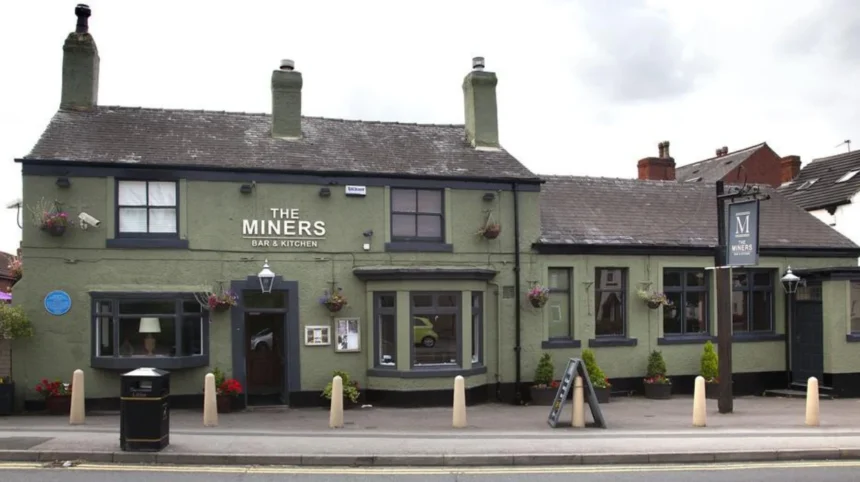
Aberford Road provides another important pub cluster. The Miners is located at 4 Aberford Road, while the Lord Gascoigne is recorded at 6 Aberford Road. Their close proximity makes this part of Garforth particularly relevant to visitors interested in local pub history.
Selby Road is important because of the Gaping Goose. Its position reflects the historic significance of the former Leeds-Selby turnpike route.
Ninelands Lane provides another modern pub option through the Crusader. Leeds CAMRA describes it as a modern two-roomed pub that was refurbished in February 2023.
These areas are close enough to form part of a broader Garforth pub exploration rather than requiring visitors to travel across the wider Leeds district.
What is the history of the Gaping Goose in Garforth?
The Gaping Goose is one of Garforth’s most historically significant pubs. It was operating by 1822 on Selby Road and served travellers using the former turnpike route between Leeds and Selby. Its building retains historic features despite later changes.
The Gaping Goose illustrates the relationship between pubs and transport infrastructure before motorised travel became dominant.
Turnpike roads were privately managed routes funded through tolls. They improved long-distance movement for travellers, traders, livestock and commercial traffic. Inns positioned along these roads provided essential services.
The Gaping Goose occupied this role on the Selby route. Its documented operation by 1822 places it within Garforth’s early nineteenth-century transport landscape.
The building underwent significant work in 1930. Despite this refurbishment, Leeds City Council records that older features remained. This makes the site relevant to visitors studying how historic pubs adapted to changing requirements.
Its name also provides an example of local cultural history. The original White Swan name disappeared following the development of the Gaping Goose nickname.
For visitors, the significance of the pub lies in its combination of age, location and documented relationship with historic travel.
Why is the Miners’ Arms important to Garforth’s industrial heritage?
The Miners’ Arms represents Garforth’s coal-mining heritage and military history. Its former names included the Black Bull and Jolly Collier, while its blue plaque commemorates former publican Sergeant Albert Mountain, a First World War Victoria Cross recipient.
The pub occupies 4 Aberford Road and continues to operate as a food and drink venue under the Miners Bar & Kitchen identity. Its current operation combines contemporary hospitality with a name that retains the area’s mining connection.
The military connection is especially significant. Sergeant Albert Mountain was associated with the pub as a former publican. Leeds City Council records his Victoria Cross and Military Medal recognition during the First World War.
The current business describes a broad drinks selection, including draught beers and lagers, wine and spirits. It also operates a food service covering dishes such as fish and chips, steak and ale pie and Sunday lunch.
The venue therefore demonstrates how an establishment can retain a historic identity while operating with a contemporary hospitality model.
Visitors interested in Garforth’s mining history should consider the Miners’ Arms as a heritage stop as well as a pub.
What can visitors expect at The Briggate in Garforth?
The Briggate is a Main Street pub occupying the former Garforth Liberal Club site. The Liberal Club operated on the site from 1886, while the current J D Wetherspoon venue opened in March 2017.
The Briggate stands at 37 Main Street, Garforth, LS25 1DS. J D Wetherspoon identifies the present pub as operating seven days a week, with food, drinks and outdoor seating facilities.
Its building has an important community history. The Garforth Liberal Club was established in 1886 in a smaller building on the same site and remained a feature of Main Street for 128 years before closing in August 2014.
The present pub opened on 7 March 2017. Leeds CAMRA describes its interior as extending considerably beyond its relatively small frontage. It also records outdoor drinking areas at the front and side.
The Briggate therefore represents a different type of local heritage. It is not an eighteenth-century coaching inn, but its site preserves a connection with a long-established community institution.
This makes it useful for visitors exploring how Garforth’s hospitality landscape has changed while remaining centred on Main Street.
Which Garforth pubs are best for understanding local community life?
Community-focused pubs provide spaces for meals, informal meetings, live entertainment and social activity. Garforth examples include The Miners and venues around Main Street, where hospitality operates alongside local events and regular customer activity.
Pubs have historically functioned as social institutions rather than simple drinking venues. Their roles include informal meetings, food service, entertainment and community interaction.
The Miners demonstrates this wider function through its food and entertainment programme. Its published information lists open-mic nights, live bands and Sunday lunch alongside its drinks service.
Main Street provides another community-oriented environment. The concentration of businesses creates a central destination where food, drink and everyday shopping occur within walking distance.
The Briggate also includes facilities such as outdoor seating and baby-changing provision, demonstrating how contemporary pubs serve a broader customer base than traditional drinking-only establishments.
For visitors, this community dimension is important. A local pub can provide information about the character of an area through its location, architecture, events and relationship with residents.
How does Garforth’s mining history influence its pub names?
Mining influenced Garforth’s pub culture through names, occupations, community institutions and local ownership. The Miners’ Arms and Jolly Collier references preserve this industrial vocabulary, while the wider town developed around the economic importance of Garforth Collieries.
Garforth’s mining history is closely linked with the Gascoigne family and the local collieries. Leeds City Council’s Neighbourhood Plan states that the Gascoigne family owned Garforth Collieries and provided facilities for mining families.
The Miners’ Arms name directly reflects this industrial identity. Its earlier names also demonstrate how pub names changed while retaining connections with local occupations and working communities.
The Jolly Collier name is particularly relevant because a collier was a worker associated with coal mining and coal transport. Such terminology was embedded in communities where mining formed an important part of employment.
Pub names therefore provide useful historical evidence. They preserve occupational language that reflects the economic structure of earlier Garforth.
Visitors exploring these names can connect individual establishments with the wider industrial landscape rather than viewing them as isolated businesses.
What should visitors look for inside a traditional Yorkshire pub?
Visitors exploring a traditional Yorkshire pub should look for historic building fabric, original room layouts, fireplaces, timber features, bar counters, entrances, signage and evidence of former accommodation or stabling. These features reveal how pubs operated before modern hospitality systems developed.
Traditional pubs often contain architectural evidence from several periods. Some features relate to their original construction, while others reflect later refurbishment.
Historic room arrangements are particularly valuable. Older pubs frequently separated drinking areas into distinct spaces, including public bars, lounges, snug rooms and private rooms.
The Miners’ Arms website describes its historical layout as including a bar, tap room, parlour, snug and upstairs club room. Its nineteenth-century site plan also recorded a brewery, stabling, cartshed, cow byre and piggery.
These features demonstrate that an inn historically operated as a wider commercial property.
A brewery indicates on-site production. Stabling supported travellers. Agricultural outbuildings connected the establishment with the rural economy.
The survival of such features varies between buildings. Visitors should therefore distinguish between original fabric and later decorative recreations.
How did coaching inns shape Garforth’s pub tradition?
Coaching inns shaped Garforth’s pub tradition by providing accommodation, food, drink, stabling and transport services along important turnpike routes. The former Old George demonstrates this role through its position at two historic road junctions and extensive stable buildings.
Before railways and motor vehicles transformed travel, stagecoach journeys depended on stopping places.
Coaching inns provided scheduled stopping points where travellers could eat, rest and change horses. They also supported commercial movement along major roads.
Garforth benefited from its position between important routes. The Old George stood at the crossroads of the Leeds-Selby and Wakefield-Tadcaster turnpike roads. Leeds City Council identifies its extensive stable blocks as evidence of its role as a substantial coaching inn.
The Gaping Goose provides another example of a pub positioned on the former Selby turnpike. Its operation by 1822 places it within the same transport environment.
This history explains why Garforth developed several significant inns.
The modern pub landscape retains traces of this earlier transport geography even though the original travel system no longer operates.
How can visitors explore Garforth’s pubs responsibly?
Visitors can explore Garforth’s pubs responsibly by checking current opening arrangements, respecting local residents, using public transport or a designated driver, following venue policies and treating historic buildings carefully. Responsible visits protect community relationships and local heritage.
Opening hours and food services change between establishments. Visitors should check the venue’s current information before travelling.
The Briggate currently publishes daily opening hours through J D Wetherspoon, while The Miners publishes separate pub and kitchen hours.
Responsible pub tourism also involves understanding that Garforth is a residential community rather than a dedicated nightlife district.
Visitors should respect noise controls, queues, smoking restrictions and outdoor seating rules. They should also avoid damaging historic fixtures, signs or architectural features.
Alcohol consumption requires particular attention to transport. Visitors should arrange a designated driver or use public transport and taxis where appropriate.
A heritage pub is also a working business. Photographs, architectural inspection and historical interest should not interfere with staff or customers.
How can a pub visit be combined with Garforth’s wider heritage?
A Garforth pub visit works best as part of a wider heritage itinerary covering Main Street, historic roads, former industrial sites and notable buildings. This approach connects hospitality with the town’s transport, agricultural, mining and architectural development.
Garforth’s history extends well beyond its pubs. Leeds City Council’s Neighbourhood Plan identifies evidence of early settlement, medieval agriculture and later industrial expansion. The Domesday Survey of 1086 recorded Garforth as a manor with a church, priest, four villagers and one smallholder.
The town’s position on Magnesian limestone contributed to agricultural development. Later expansion was linked to landownership, transport and mining.
The pub network reflects these changes.
The Gaping Goose represents turnpike travel. The Old George represents coaching. The Miners’ Arms represents coal mining. The Lord Gascoigne represents the influence of the Gascoigne estate. The Briggate represents a later community institution and modern hospitality development.
This creates a useful chronological framework for visitors.
Rather than treating each pub as an isolated destination, visitors can use the buildings to understand how Garforth changed from a rural settlement into an important urban community within Leeds.
Explore More Area Guide
Garforth Best Places for an Early Evening Stroll 2026
Garforth Libraries and Cultural Spaces Guide 2026
Why does Garforth’s traditional pub heritage remain relevant today?
Garforth’s traditional pub heritage remains relevant because historic public houses preserve evidence of transport, employment, architecture and community life. Current venues also provide food, drink and social facilities, keeping former community spaces active within modern Garforth.
The continued presence of historic pub names and sites provides a direct connection between present-day Garforth and earlier generations.
The town’s Neighbourhood Plan specifically identifies historic public houses among its local heritage assets. This recognition demonstrates that pubs contribute to the area’s built environment and historical character.
Modern operations also show adaptation. The Miners combines a mining-associated identity with contemporary food, drinks and entertainment. The Briggate operates from a site previously occupied by the Garforth Liberal Club.
This combination of preservation and adaptation gives Garforth’s pub landscape continuing relevance.
For tourists, the pubs provide accessible heritage experiences. For residents, they remain part of the local social infrastructure. For business travellers and visitors with limited free time, their central locations provide an efficient way to experience local history alongside food and drink.
Garforth’s pubs therefore form an important part of the town’s cultural geography. Their locations, names and buildings preserve evidence of the forces that shaped the settlement.
What is the best way to plan a Garforth pub and heritage visit?
The most effective approach is to start around Main Street, continue towards Aberford Road, include the historically significant Miners’ Arms and Gaping Goose, and research current opening arrangements before travelling. This route combines modern hospitality with documented local history.
Main Street provides a practical starting point because it contains established hospitality venues and sits at the centre of Garforth’s commercial area.
Visitors can then explore Aberford Road and examine the relationship between the Miners’ Arms, Lord Gascoigne and the wider historic townscape.
A separate visit to the Gaping Goose on Selby Road adds the important turnpike dimension.
The former Old George site provides another historical reference point, particularly for visitors interested in coaching inns and historic road networks. Its legacy remains visible through the Old George roundabout name and documented historical importance.
Current venue information should always take priority for opening hours, food service and events. Leeds CAMRA provides a useful pub guide, while individual venues publish their own operational information.
The result is a compact heritage-focused exploration of Garforth.
Visitors can experience contemporary pubs while also understanding the transport, mining, landownership and community structures that shaped the town.
What are the most historic pubs in Garforth?
The Gaping Goose, Miners’ Arms, Lord Gascoigne and former Old George site have strong historical connections. Their histories cover turnpike travel, coaching, coal mining, local estates and community development.