Headingley’s cemetery and memorial heritage provides an important record of the neighbourhood’s religious history, population growth, architecture and changing approaches to commemoration. Churchyards, burial grounds and nearby municipal cemeteries preserve physical evidence of the people and institutions that shaped this part of Leeds.
- What is Headingley’s cemetery and memorial heritage?
- Why did cemeteries become important to the development of Leeds and Headingley?
- Which historic burial places are most relevant to visitors exploring Headingley?
- What do gravestones and memorials reveal about local history?
- How does Lawnswood Cemetery represent Victorian memorial heritage?
- How can visitors research graves and burial records around Headingley?
- What is the correct way to visit cemeteries and memorial sites respectfully?
- How do war memorials and collective memorials add to Headingley’s heritage?
- Why are cemeteries important for architecture, landscape and biodiversity?
- What future role will Headingley’s cemetery heritage play?
For visitors, local cemeteries are heritage landscapes rather than conventional tourist attractions. They contain historic buildings, gravestones, mature trees, war memorials and burial records. A respectful visit provides a direct connection with the development of Headingley from an ancient settlement into a major Leeds suburb.
The wider Leeds burial landscape also explains why cemetery heritage became increasingly important during the nineteenth century. Leeds experienced rapid population growth during the Industrial Revolution, placing pressure on traditional parish churchyards. New burial grounds were established to provide additional space and serve expanding communities. Historic England identifies Beckett Street Cemetery, established in 1845, as one of the earliest publicly funded cemeteries in England.
Headingley has its own long-established churchyard heritage, while Lawnswood Cemetery, on the Otley Road corridor close to Headingley and Adel, represents the large Victorian cemetery landscape that served the expanding northern districts of Leeds. Leeds City Council records Lawnswood Cemetery as opening in 1876 and Lawnswood Crematorium as opening in 1905.
What is Headingley’s cemetery and memorial heritage?
Headingley’s cemetery and memorial heritage includes historic churchyards, graves, monuments, commemorative features and nearby Victorian burial landscapes. Together, these places record local religious life, family history, population change, military remembrance and the architectural development of the wider Headingley area.
Cemetery heritage is the physical and documentary evidence associated with burial and remembrance. It includes grave markers, headstones, mausoleums, boundary walls, chapels, pathways, planting schemes and burial registers. Each component provides different information about the history of a place.
A churchyard is land surrounding or adjoining a church that has traditionally been used for burials. A cemetery is a designated burial ground that can be managed by a local authority, religious body or other organisation. A memorial is a structure, inscription or object created to commemorate a person, group or event.
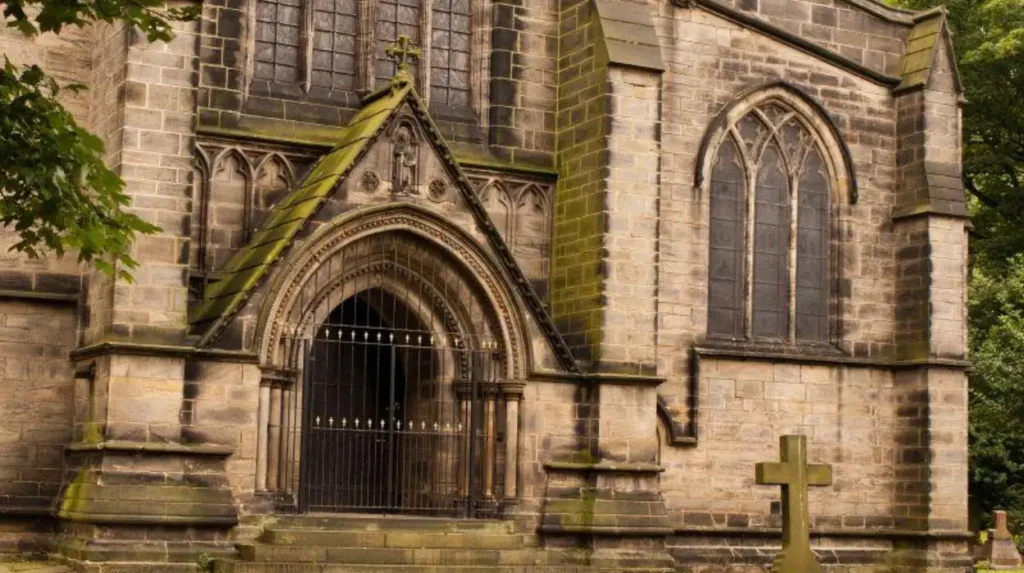
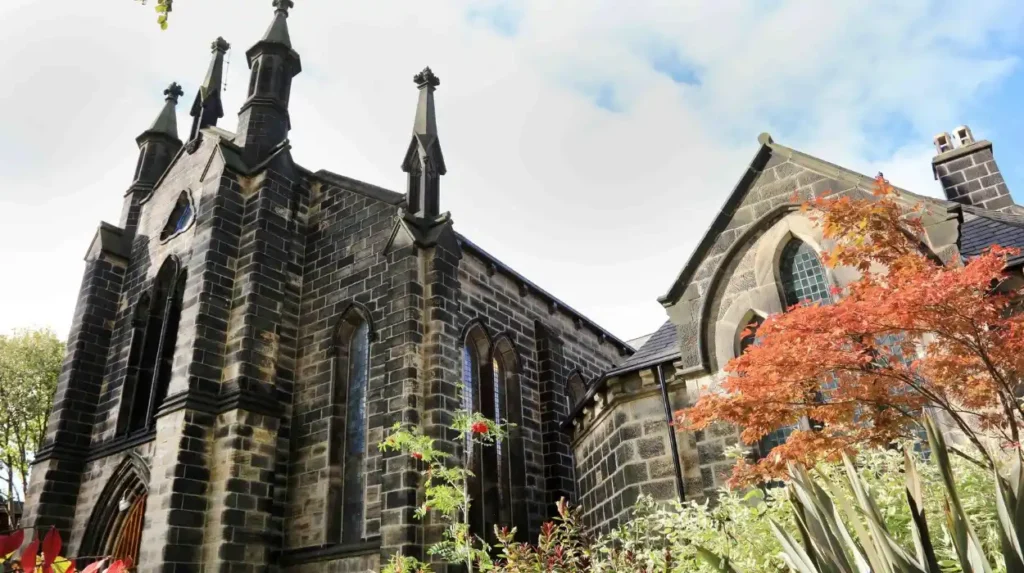
In Headingley, the historic churchyard at St Michael and All Angels forms an important part of the neighbourhood’s older burial heritage. The churchyard connects present-day visitors with the long religious history of the settlement. Burial records also provide evidence of generations of local residents.
The wider heritage landscape extends beyond the immediate centre of Headingley. Lawnswood Cemetery represents a major Victorian development on the northern approach to Leeds. Historic England records that the cemetery was designed by Leeds architect George Corson, with landscape gardening input from William Gay of Bradford, and opened in 1875. It is registered at Grade II for its special historic interest.
These sites should be understood as historic landscapes. The arrangement of paths, planting and monuments forms part of their significance. A cemetery therefore preserves more than individual graves. It preserves a planned environment shaped by the social and cultural practices of its period.
Why did cemeteries become important to the development of Leeds and Headingley?
Cemeteries became increasingly important as nineteenth-century population growth placed pressure on traditional churchyards. New burial grounds provided additional capacity, organised burial space and formal memorial landscapes, reflecting major changes in public health, urban administration and religious practice across Leeds.
The nineteenth century transformed Leeds. Industrial growth increased the population and expanded the built-up area. Traditional churchyards had limited space and were increasingly unable to meet the burial needs of a rapidly growing town.
The public health context was also significant. The University of Leeds holds the archive of the Leeds General Cemetery Company, established in 1833 following concerns about inadequate burial provision after the cholera outbreak of 1832. The company selected land at St George’s Fields near Woodhouse Moor, close to the historic route towards Headingley and Otley. The cemetery was also known as Woodhouse Cemetery.
This development demonstrates the close relationship between urban growth, public health and burial reform. Cemeteries became planned spaces with defined boundaries, burial sections and formal routes. They also created new opportunities for architectural design and landscape planning.
Headingley was changing at the same time. The area developed from an older rural settlement into an increasingly connected suburb of Leeds. Housing, transport, churches and public institutions expanded as the population grew. Burial provision formed part of this wider transformation.
As you explore the modern neighbourhood, you are crossing land with a deep heritage. Read about the full [Headingley Guide to Local History and Heritage] to understand its origins.
The creation of larger cemeteries outside densely built areas also changed the geography of remembrance. Families travelled to dedicated burial landscapes, where graves were arranged within planned grounds. This pattern remains visible at Lawnswood and other nineteenth-century cemeteries across Leeds.
Which historic burial places are most relevant to visitors exploring Headingley?
The most relevant burial heritage locations are Headingley’s historic churchyards and nearby Lawnswood Cemetery. St Michael and All Angels represents older parish burial traditions, while Lawnswood provides a large Victorian cemetery landscape with significant architectural and commemorative heritage.
St Michael and All Angels Church stands within the historic core of Headingley. Its churchyard is particularly important for understanding the continuity of parish life and local burial customs. Churchyard monuments often record names, occupations, family relationships and dates of death.
Burial record projects provide further evidence of the scale of this heritage. Yorkshire Burials records 3,937 burials for St Michael and All Angels across registers covering 1813 to 1953. The records demonstrate how burial documentation supports family and local history research.
Visitors should remember that a churchyard remains a place of worship and commemoration. The site should be approached quietly and with respect for services, mourners and the condition of historic monuments.
Lawnswood Cemetery is another important location for understanding the burial heritage associated with Headingley and north-west Leeds. The cemetery occupies a large landscape and contains graves from the late nineteenth and twentieth centuries. It is also associated historically with the wider Headingley-cum-Burley area.
Yorkshire Burials describes Lawnswood as also being known as Headingley-cum-Burley Cemetery and records burial documentation covering 1870 to 1992. The site contains a substantial number of historic burial records and photographed grave monuments.
A visitor exploring these locations gains two different perspectives on local history. The churchyard represents the older parish model of burial centred on a place of worship. The Victorian cemetery represents the planned municipal and civic approach that developed during a period of rapid urban growth.
What do gravestones and memorials reveal about local history?
Gravestones and memorials reveal names, dates, family relationships, occupations, religious beliefs and changing styles of commemoration. Their materials, inscriptions and designs also provide evidence of local craftsmanship, social status and the historical development of burial traditions.
A gravestone is a historical document as well as a memorial. The inscription often records information that is unavailable in the surrounding landscape. Names establish identity. Dates provide a chronological record. Family references show relationships between parents, children, spouses and wider relatives.
Occupational descriptions can also be historically valuable. A monument that identifies a person as a doctor, engineer, teacher, merchant or other worker contributes to an understanding of the economic and social history of the community.
Memorial design reflects changing tastes. Older monuments often use traditional forms, including upright headstones and carved religious symbols. Victorian cemeteries introduced a wide range of monumental styles, with elaborate stonework appearing alongside simpler family markers.
The materials used also matter. Stone type can indicate local geology, commercial supply networks and the availability of specialist craftsmen. Weathering, biological growth and pollution leave visible evidence of the environmental history of a monument.
Inscriptions should be treated carefully during a visit. Rubbing, cleaning or tracing directly on a fragile gravestone can damage historic surfaces. Photography from a respectful distance is generally a safer method of recording visible information.
The absence of a surviving memorial also has historical significance. Not every burial was marked by a permanent stone. Financial circumstances, changing cemetery policies and later removal of unstable monuments have affected what survives in the landscape.
How does Lawnswood Cemetery represent Victorian memorial heritage?
Lawnswood Cemetery represents Victorian memorial heritage through its planned landscape, architectural design, historic monuments and long-term burial function. Its Grade II registration recognises the special historic interest of the cemetery as a designed landscape within the Leeds area.
Victorian cemeteries were often designed as complete landscapes. Architects and landscape specialists considered circulation, planting, views and the placement of buildings. The result was a structured environment where commemoration and landscape design operated together.
Historic England identifies George Corson as the architect associated with Lawnswood Cemetery and William Gay of Bradford as the landscape gardener who assisted with its design. The cemetery opened in 1875 according to the Historic England record, while Leeds City Council lists the cemetery opening year as 1876. These records reflect the distinction that can occur between the completion and operational history of a historic site.
The Grade II registration places the cemetery within England’s recognised heritage framework. Registered parks and gardens are identified because of their special historic interest. The designation draws attention to the importance of the landscape as a whole rather than focusing only on individual monuments.
Lawnswood also demonstrates the transition in funerary practice during the early twentieth century. Leeds City Council records the opening of Lawnswood Crematorium in 1905. This added cremation to the services available within the wider memorial landscape.
For heritage visitors, the site provides evidence of more than one period. Victorian burial traditions, twentieth-century memorial practices and modern cemetery management are all present within the same wider landscape.
How can visitors research graves and burial records around Headingley?
Visitors can research burial heritage through cemetery records, church registers, local archives and specialist historical databases. A successful search uses a person’s full name, approximate death date and known location to connect documentary records with surviving burial sites.
Burial research starts with accurate identifying information. A full name is useful, but names are frequently repeated across generations. An approximate date of death, age, address, religious affiliation or family relationship can help distinguish between people with similar names.
Church burial registers are an important source for older local history. They can record the date of burial and basic information about the deceased. Cemetery registers can provide additional details, including grave numbers and burial sections.
Leeds City Council provides information about searching burial records for council-managed cemeteries and crematoria. The council states that older records present particular challenges, noting that there are no computerised records prior to June 1987 and that many records are not indexed. A paid search service can identify a grave number and section when sufficient information is available.
The University of Leeds Special Collections also preserves records connected with the Leeds General Cemetery Company. Archival collections can contain administrative records, plans and historical documents that explain how burial grounds were established and managed.
Online transcription projects add another research route. Yorkshire Burials has published transcribed information for several Leeds burial locations, including St Michael and All Angels and Lawnswood. Transcriptions are useful for locating names, but researchers should verify important historical information against original records where possible.
A grave location should not be treated as the end of the research process. Census records, probate records, newspapers and local archives can provide further information about the person commemorated.
What is the correct way to visit cemeteries and memorial sites respectfully?
Respectful cemetery visits require quiet behaviour, care around graves and monuments, compliance with site rules and sensitivity towards mourners. Visitors should stay on appropriate routes, avoid disturbing services and treat every memorial as a place of personal and historical significance.
Cemeteries serve several purposes at the same time. They are active places of remembrance, working burial grounds, historic landscapes and wildlife habitats. Visitors should recognise all of these functions.
The first requirement is consideration for bereaved families. Funeral services and private visits take priority over sightseeing or historical photography. Noise should be kept low, and visitors should avoid gathering close to people who are mourning.
Graves and monuments should not be climbed on, leaned against or used as seating. Older headstones can be unstable. Physical contact can also damage stone surfaces, lettering and decorative details.
Leeds City Council publishes opening information for its cemetery and crematorium grounds. The council states that grounds generally open from 8:30am until dusk on weekdays and from 10am until dusk on weekends and bank holidays. Visitors should check current site information before travelling because operational arrangements can change.
Photography should be undertaken discreetly. Images of historic architecture and monuments can support heritage research, but visitors should respect privacy and avoid photographing mourners without permission.
Dogs, vehicles, cycling and other activities are subject to individual site rules. The appropriate approach is to check local guidance and follow notices displayed at entrances.
Respectful behaviour protects both people and heritage. It also ensures that cemetery tourism remains compatible with the primary purpose of these places: remembrance.
How do war memorials and collective memorials add to Headingley’s heritage?
War memorials and collective memorials record shared experiences of conflict, public service and community loss. They complement individual graves by preserving names and events that shaped local and national history across several generations.
Individual graves record personal lives. Collective memorials record a wider group, institution or event. War memorials are among the most recognisable examples of public commemoration in Britain.
The First World War of 1914 to 1918 and the Second World War of 1939 to 1945 produced extensive memorial activity across towns, villages, workplaces, schools and religious communities. Names were recorded on monuments so that local communities could preserve a public record of those who died.
Churches and cemeteries form important settings for this type of remembrance. A memorial can identify local residents, former parish members or people connected with a particular institution. The location of a memorial is therefore part of its historical meaning.
Visitors researching military heritage should distinguish between a war grave and a civic war memorial. A war grave marks an individual burial. A civic memorial commemorates people collectively and does not necessarily indicate that those named are buried at the same location.
Memorial heritage also extends beyond warfare. Communities commemorate disasters, public service, religious figures and local benefactors. These memorials demonstrate which events and individuals were considered important enough to receive permanent recognition.
Careful reading of names and dates can reveal connections between a memorial and the wider history of Headingley. The monument should then be interpreted within its local setting rather than treated as an isolated object.
Explore More Area Guide
Headingley Public Art and Sculptures Guide
Headingley Historic Gardens and Designed Landscapes Guide
Why are cemeteries important for architecture, landscape and biodiversity?
Cemeteries are important heritage landscapes because they combine architecture, designed planting, mature trees and historic monuments. Their long-term protection also supports urban green space, ecological habitats and opportunities for public understanding of local environmental and cultural history.
Historic cemeteries are distinctive urban landscapes. They contain built structures and natural features that have developed together over long periods.
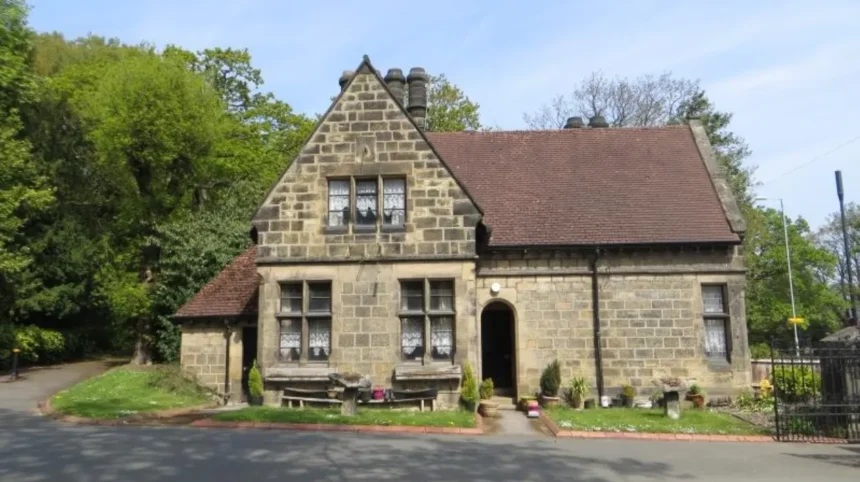
Architecture includes chapels, lodges, entrance gates, boundary walls and other designed elements. These structures establish the identity and character of a cemetery. Their survival helps researchers understand the original plan of the site.
Landscape features include avenues, paths, grass areas and mature trees. At Lawnswood, the historic design significance of the landscape is recognised through its Grade II registration.
Trees and established vegetation also create ecological value. Older burial grounds can contain habitats that are uncommon in heavily developed neighbourhoods. However, heritage management requires a balance between ecological growth and monument conservation. Roots, branches and dense vegetation can damage historic structures if they are not managed carefully.
The cemetery therefore requires coordinated stewardship. Conservation work addresses the condition of buildings and monuments. Grounds management addresses safety, access and planting. Record keeping preserves information about people and burials.
For visitors, this combination creates a distinctive form of local heritage. A walk through a cemetery can reveal architectural history, landscape design, family history and environmental change within a single place.
What future role will Headingley’s cemetery heritage play?
Headingley’s cemetery heritage will remain important for historical research, remembrance, conservation and public education. Digital records and heritage documentation improve access to information, while careful management protects historic landscapes and memorials for future generations of visitors and local communities.
The future of cemetery heritage depends on both physical conservation and access to information. A monument that survives without a readable record can become difficult to interpret. A burial record without a surviving landscape loses important physical context.
Digital transcription projects are helping make historical information more accessible. The availability of searchable records for sites such as St Michael and All Angels and Lawnswood allows researchers to begin investigations remotely before visiting the area.
Local authority records remain equally important. Leeds City Council manages a substantial network of burial and cremation sites and provides formal procedures for locating graves and accessing bereavement information.
Future conservation will also require practical decisions about weathering, unstable monuments, ageing infrastructure and changing patterns of burial and remembrance. Historic cemeteries cannot remain unchanged, but management should recognise their cultural significance.
For Headingley, cemetery and memorial heritage provides a valuable link between the neighbourhood’s past and present. Churchyards preserve evidence of the older settlement. Victorian cemetery landscapes document the expansion of Leeds. Memorials record individual and collective lives across generations.
Visitors gain the most from these places when they combine observation with research and respect. Reading the landscape, understanding the history and following site rules creates a more accurate and responsible approach to local heritage.
Headingley’s cemeteries and memorials are therefore part of a wider historical record. They preserve names, dates, architecture and landscapes that explain how the neighbourhood changed. Their continuing value lies in remembrance, research and the protection of shared local history.
What are the main historic cemeteries near Headingley?
The main burial heritage locations associated with Headingley include the churchyard of St Michael and All Angels and nearby Lawnswood Cemetery. These sites preserve historic graves, monuments and records that document the development of Headingley and north-west Leeds.