House cleaning and domestic support services help households maintain clean, safe and organised living spaces. In Headingley, these services support residents, landlords, students, professionals and temporary visitors who need practical assistance with regular household tasks and property upkeep.
- What are house cleaning and domestic support services?
- Why do people in Headingley use domestic cleaning services?
- What does a standard house cleaning service usually include?
- How do regular cleaning, deep cleaning and specialist cleaning differ?
- How can you choose a reliable house cleaning provider in Headingley?
- What should you check before booking a domestic support service?
- How much do house cleaning and domestic support services cost?
- What household support can be provided alongside cleaning?
- How can tenants, landlords and visitors use cleaning services effectively?
- What health, safety and environmental standards apply to domestic cleaning?
- How should you prepare your home for a cleaner or domestic support worker?
- How are domestic cleaning services likely to develop in Headingley?
- How can you find the right house cleaning and domestic support service in Headingley?
Headingley is a busy residential district in north-west Leeds. Its housing includes family homes, flats, shared houses and student accommodation. The area’s large student population, private rented sector and proximity to the University of Leeds create consistent demand for domestic cleaning and household support.
House cleaning services cover routine tasks such as vacuuming, dusting, mopping, bathroom cleaning and kitchen cleaning. Domestic support services have a wider role. They can include laundry, bed changing, shopping assistance, meal preparation, household organisation and other practical help, depending on the provider’s service scope.
Choosing an appropriate service requires a clear understanding of the work required, the provider’s employment status, insurance arrangements, safeguarding responsibilities and pricing structure. Households also need to distinguish between standard domestic cleaning, specialist cleaning and regulated care services.
For visitors and business travellers staying in Headingley, domestic support can provide practical help during longer stays. For residents, regular cleaning services reduce the time spent on routine household work. Landlords and tenants also use professional cleaning for tenancy changes and property preparation.
The local context matters when arranging household services. Access arrangements, parking restrictions, property type and the number of occupants all affect the time required to complete cleaning work. Clear communication before a booking establishes what the service includes and prevents misunderstandings.
As Headingley continues to combine residential, student and visitor activity, reliable domestic support remains part of the wider local service economy.
What are house cleaning and domestic support services?
House cleaning services focus on maintaining the cleanliness of a property, while domestic support covers wider practical household assistance. Services range from regular cleaning and laundry to household organisation and shopping support, with the exact work determined by the provider and agreed service arrangement.
House cleaning is the organised completion of routine cleaning tasks within a home or residential property. A cleaner usually works to an agreed schedule and task list. Common services include cleaning kitchens, bathrooms, bedrooms and living areas.
Domestic support is a broader term. It describes practical assistance that helps a person or household manage everyday domestic activities. The work remains separate from regulated personal care unless the provider is registered and authorised to deliver care services.
Three common forms of domestic cleaning are regular cleaning, one-off cleaning and specialist cleaning. Regular cleaning includes recurring tasks such as vacuuming and bathroom cleaning. One-off cleaning addresses a specific need, such as preparing a property for an event. Specialist cleaning includes examples such as end-of-tenancy cleaning, deep cleaning and post-building-work cleaning.
Three common forms of domestic support are household assistance, laundry support and practical errands. Household assistance includes changing bed linen and organising living spaces. Laundry support includes washing, drying and folding clothes. Practical errands include agreed shopping and household collection tasks.
The distinction between cleaning and care is important. The Care Quality Commission regulates certain health and adult social care activities in England. A standard domestic cleaner does not automatically provide personal care, medication support or other regulated activities.
Households should define the required service before contacting a provider. A clear description of the property and tasks allows the provider to assess the work accurately.

Why do people in Headingley use domestic cleaning services?
People in Headingley use domestic cleaning and support services because the area contains busy households, shared accommodation, rental properties and temporary visitors. Professional assistance helps manage routine domestic work when residents, tenants or visitors have limited time for household tasks.
Headingley has a mixed residential population. Students often live in shared houses with several occupants. Professionals commute to workplaces across Leeds. Families manage work, education and household responsibilities. Each group has different domestic support requirements.
Shared accommodation creates a high volume of routine cleaning. Kitchens and bathrooms receive frequent use. Communal areas require clear cleaning arrangements. A professional cleaner can work to an agreed schedule covering shared spaces.
Private rented properties also create demand for cleaning services. Tenants use cleaners for regular maintenance and when preparing a home for inspection or departure. Landlords and property managers arrange cleaning between tenancies to prepare accommodation for incoming occupants.
Longer-term visitors use domestic services for practical reasons. Business travellers staying for extended periods need laundry or cleaning assistance. Digital nomads working from temporary accommodation benefit from organised and clean living spaces. Leisure travellers in serviced accommodation expect properties to meet appropriate cleanliness standards.
Household support also helps people manage changes in their circumstances. A new baby, demanding work schedule or temporary reduction in available time can increase the need for practical assistance.
Domestic cleaning supports the wider functioning of a household. It does not replace the need for property repairs or specialist maintenance. A cleaner identifies visible cleanliness issues, while qualified tradespeople address problems involving electrical systems, plumbing or structural defects.
For wider information about the area’s development and local identity, explore the full [Insert Anchor Text for History Article Here] to understand the historical background of modern Headingley.
What does a standard house cleaning service usually include?
A standard house cleaning service usually covers routine tasks in kitchens, bathrooms, bedrooms and living spaces. Typical work includes dusting, vacuuming, mopping and surface cleaning, although the exact task list, equipment and products depend on the agreement with the provider.
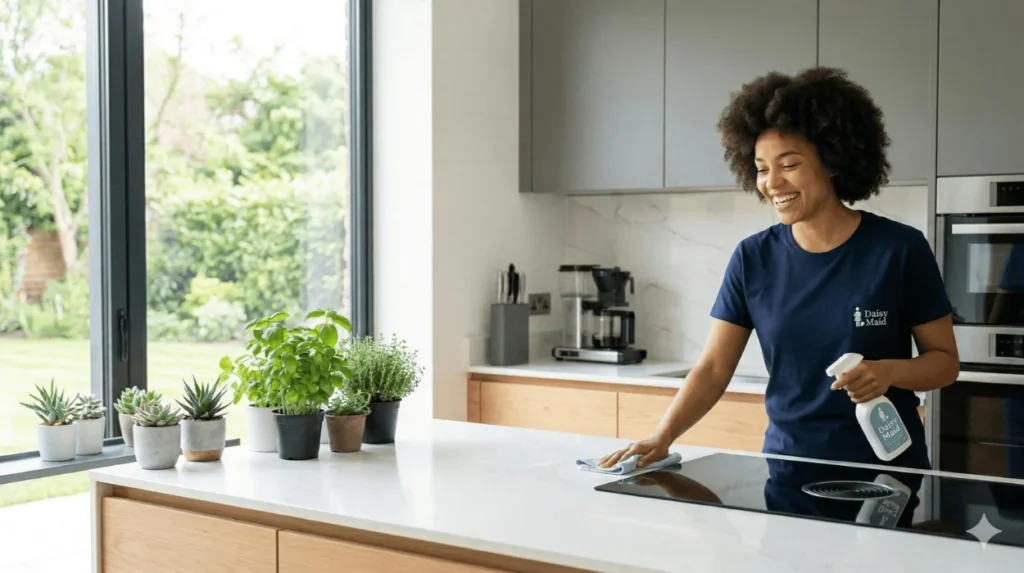
The kitchen is a central part of routine domestic cleaning. Standard tasks often include wiping worktops, cleaning accessible appliance surfaces, washing sinks and removing everyday dirt from floors. Internal oven cleaning, refrigerator cleaning and heavy grease removal usually require specific arrangements.
Bathroom cleaning focuses on hygiene-sensitive surfaces. A routine service generally covers toilets, sinks, baths, showers, mirrors and floors. The provider and household should agree how cleaning products are supplied and whether particular products are required.
Living areas and bedrooms require regular removal of dust and surface dirt. Vacuuming carpets, cleaning hard floors and dusting accessible furniture are common tasks. Bed changing is sometimes offered as an additional domestic support service.
Three examples of regular floor cleaning are vacuuming carpets, sweeping hard surfaces and mopping sealed floors. Different flooring materials require appropriate products and methods. The household should tell the cleaner about delicate surfaces or manufacturer instructions.
A standard cleaning service generally focuses on accessible areas. High-level cleaning, external window cleaning and hazardous contamination require specialist equipment or training.
A written task list creates a consistent service. It should identify the rooms included, the tasks expected and any areas that are excluded. This document is useful when different cleaners attend the property.
How do regular cleaning, deep cleaning and specialist cleaning differ?
Regular cleaning maintains everyday cleanliness, deep cleaning addresses accumulated dirt in detailed areas, and specialist cleaning handles specific property conditions. Each service has a different scope, duration and price because the equipment, labour and technical requirements are not the same.
Regular cleaning follows a repeated schedule. The purpose is ongoing maintenance. Weekly and fortnightly appointments are common examples. The cleaner concentrates on the areas that experience routine use.
Deep cleaning involves a more detailed process. It addresses areas that receive less attention during standard cleaning. Examples include cleaning behind accessible furniture, detailed skirting boards, internal cupboards and heavy bathroom or kitchen buildup.
Specialist cleaning is designed for a particular condition or property requirement. Three examples are end-of-tenancy cleaning, post-construction cleaning and carpet cleaning. End-of-tenancy cleaning prepares a rented property for handover. Post-construction cleaning removes building dust and residues. Carpet cleaning uses equipment and cleaning methods designed for textile floor coverings.
Specialist work often requires a property assessment. The provider needs to understand the size of the area, the level of contamination and the materials involved.
Households should avoid assuming that a standard cleaning appointment includes deep or specialist work. The requested service should be stated before the booking is confirmed.
How can you choose a reliable house cleaning provider in Headingley?
A reliable house cleaning provider has a clearly defined service, transparent pricing, suitable insurance and consistent communication. Customers should confirm the provider’s employment arrangements, experience, cancellation terms and procedures for property access before allowing work to begin inside the home.
The first step is to identify the required tasks. A provider can give more accurate information when the customer explains the property type, number of rooms and specific cleaning requirements.
Insurance is an important consideration. Public liability insurance covers certain claims connected with the provider’s work. Customers should ask what insurance the business or individual holds and understand the limits of that cover.
Employment arrangements also matter. Some cleaners operate as self-employed individuals. Others work through cleaning companies. The structure affects who manages scheduling, replacement staff and service complaints.
Three useful areas to check are experience, references and service policies. Experience shows familiarity with relevant cleaning work. References provide information about previous customer experiences. Service policies explain cancellation rules, payments and other booking conditions.
A written quote should explain how the price is calculated. Some providers charge an hourly rate. Others offer a fixed price for a defined service. A fixed quote should identify the tasks included.
Clear communication protects both parties. The household should explain access arrangements, security requirements and any areas that are off limits. The provider should explain arrival times and procedures for changes to appointments.
Personal recommendations and established local service directories can help identify providers. Information should still be checked directly with the business before a booking.
What should you check before booking a domestic support service?
Before booking domestic support, customers should confirm the exact tasks, cost, timing, insurance, access arrangements and cancellation policy. Households should also establish whether the requested support involves regulated care, safeguarding requirements or specialist work beyond ordinary domestic assistance.
A service agreement does not need to be complicated, but it should be clear. The household and provider should understand the same scope of work.
The task list should identify priorities. For example, a household can specify that the kitchen and bathrooms receive attention at every visit while bedrooms are cleaned on an alternating schedule.
Access is another important issue. Some customers remain at home during appointments. Others provide a key or another agreed method of entry. Keyholding requires clear security procedures and should only be arranged with a trusted provider.
Three details that should be agreed in advance are appointment duration, cleaning supplies and payment method. Appointment duration determines how much work can be completed. Cleaning supplies establish who provides products and equipment. Payment arrangements explain when and how the provider is paid.
Households should disclose relevant property information. This includes pets, access difficulties and fragile items. Providers need accurate information to plan their work safely.
If a person requires assistance with washing, dressing, medication or other personal care, the household must establish whether the provider is authorised and appropriately regulated to deliver that service. Domestic cleaning is not a substitute for regulated care.
How much do house cleaning and domestic support services cost?
The cost of house cleaning and domestic support depends on the service type, property size, location, duration and frequency. Regular cleaning usually uses hourly or recurring rates, while deep cleaning and specialist work are commonly priced according to the defined scope of work.
There is no single standard price for domestic cleaning in Headingley or Leeds. Providers set their own rates based on business costs, staffing and service requirements.
Regular cleaning is commonly charged by the hour. The final cost depends on the number of hours required and the frequency of appointments. A larger property generally requires more time.
One-off services are often priced differently. Deep cleaning requires more detailed labour than routine maintenance. End-of-tenancy cleaning can also depend on the number of bedrooms, bathrooms and additional areas.
Three factors that influence cleaning costs are property size, service frequency and task complexity. A larger property requires more labour. Regular bookings allow a consistent maintenance routine. Complex tasks require additional time, equipment or training.
Customers should compare the scope rather than only comparing the headline price. A lower quote covering fewer tasks does not provide the same service as a higher quote with a detailed specification.
A written quotation is useful for larger or specialist jobs. It should state whether cleaning products, equipment and any additional charges are included.
What household support can be provided alongside cleaning?
Household support can include practical non-personal-care tasks such as laundry, bed changing, shopping and basic household organisation. The available services depend on the provider, and customers should agree each task in advance to establish clear responsibilities and appropriate boundaries.
Laundry support is a common additional service. The work can include washing, drying, folding and putting away clothing when agreed with the customer.
Bed changing is another practical household task. Fresh linen can be supplied by the household, while the support worker removes used linen and prepares the bed.
Shopping assistance provides help with everyday household supplies. The arrangement should establish how purchases are paid for and how receipts are handled.
Three examples of household organisation are arranging cupboards, sorting household items and preparing rooms for regular use. These tasks focus on practical organisation rather than professional decluttering or removal services.
Domestic support providers have different service boundaries. Some focus entirely on cleaning. Others offer a wider range of household tasks. Customers should not assume that every cleaner provides errands, food preparation or other forms of support.
Where support is provided to an older or vulnerable person, safeguarding and appropriate service arrangements become especially important. Families should check the provider’s procedures and confirm whether the work falls within the scope of domestic assistance or regulated care.
How can tenants, landlords and visitors use cleaning services effectively?
Tenants, landlords and visitors use cleaning services for different property requirements. Tenants maintain shared and rented homes, landlords prepare properties between occupancies, and visitors manage longer stays. Clear service specifications ensure the cleaning arrangement matches the property’s purpose and condition.
Tenants often arrange regular cleaning to manage shared accommodation. A clear agreement between housemates helps define who is responsible for booking and paying for the service.
Before moving out, tenants should check their tenancy agreement and inventory. A professional cleaning service does not automatically guarantee the return of a tenancy deposit. The condition of the property and compliance with the tenancy agreement remain relevant.
Landlords use cleaning services between occupancies. The work prepares the property for new residents and helps maintain a consistent presentation standard.
Property managers require reliable scheduling. Cleaning often needs to take place within a short period between one occupancy and the next. Access and key arrangements must be managed securely.
Visitors use domestic support differently. Extended-stay guests benefit from fresh linen, laundry assistance and scheduled cleaning where accommodation arrangements permit it. Business travellers can reduce time spent on routine household tasks.
For all users, the service should match the property agreement. Guests should not arrange unauthorised services in accommodation without checking the relevant terms or speaking with the property manager.
What health, safety and environmental standards apply to domestic cleaning?
Domestic cleaning requires safe working practices, suitable cleaning products and clear procedures for household hazards. Providers and customers should consider product labels, ventilation, equipment safety and waste handling, while avoiding tasks that require specialist qualifications or hazardous materials management.
Cleaning products contain chemicals that require proper use. Product labels provide information about handling and storage. Products should not be mixed unless the manufacturer specifically states that they are compatible.
Ventilation is important when using cleaning products. Bathrooms and kitchens can contain concentrated cleaning residues or reduced airflow. Appropriate ventilation supports safer working conditions.
Equipment must also be maintained. Vacuum cleaners, electrical appliances and extension leads should be used according to safety instructions.
Three common household hazards are wet floors, damaged electrical equipment and unsafe storage of cleaning chemicals. Wet floors create a slipping risk. Damaged electrical equipment creates a potential electrical hazard. Cleaning chemicals should be stored securely and according to their instructions.
Environmental considerations are increasingly relevant. Customers and providers can discuss concentrated products, reusable cleaning cloths and accurate product dosing. Environmental claims should be based on the product’s verified information rather than general marketing language.
Specialist hazards require specialist services. Examples include asbestos-containing materials, serious mould contamination and hazardous waste. A standard domestic cleaner should not be expected to undertake work outside their competence.
How should you prepare your home for a cleaner or domestic support worker?
Preparing a home before a cleaning appointment improves efficiency and establishes clear working conditions. Customers should secure valuables, identify priority tasks, provide agreed access and explain household hazards so the provider can begin work safely and focus on the required service.
The first preparation step is to remove unnecessary obstacles from the areas being cleaned. A clear floor allows vacuuming and mopping to proceed efficiently.
Priority tasks should be communicated before the appointment. This is particularly important when the booked time does not cover every room.
Valuables and sensitive documents should be stored securely. This is a sensible household security practice for any visitor entering a property.
Three pieces of information to provide are access instructions, pet arrangements and product preferences. Access instructions explain how the provider enters the property. Pet arrangements protect both the animal and the worker. Product preferences identify any agreed cleaning products.
The household should also explain areas that are private or excluded from the service. Clear boundaries prevent confusion.
Preparation supports efficient work, but it does not transfer the provider’s responsibilities to the customer. The agreed service specification remains the basis of the appointment.
Explore More Area Guide
Headingley Roofing Contractors and Roof Maintenance in Leeds
Headingley Electricians: Local Electrical Repairs and Services
How are domestic cleaning services likely to develop in Headingley?
Domestic cleaning and household support services will remain relevant as Headingley continues to serve students, professionals, families and temporary visitors. Future service development will focus on flexible booking, clearer service standards, efficient scheduling and increasing attention to environmental and household safety practices.
The local demand for practical services is connected to how people use housing. Shared properties require regular maintenance of communal areas. Rental properties require cleaning between occupancies. Busy households continue to use external support for routine domestic tasks.
Digital booking systems have changed how many local services are arranged. Customers increasingly expect clear online information about availability, service scope and pricing. Direct communication remains important because every property has different requirements.
Environmental standards are also shaping customer expectations. Product information, reduced waste and efficient use of supplies form part of wider household sustainability practices.
Professional standards will remain important. Clear terms, suitable insurance and defined service boundaries help customers understand what they are purchasing.
The strongest long-term approach is straightforward. Households should identify their practical needs, choose an appropriate provider and agree the service in clear terms. Providers should communicate accurately about their services and maintain safe working practices.
How can you find the right house cleaning and domestic support service in Headingley?
The right house cleaning or domestic support service matches the household’s specific tasks, schedule and budget. Customers should compare service scope, verify practical arrangements and use clear written communication to create a reliable arrangement that supports the property and its occupants.
The process begins with a realistic assessment of household needs. Regular cleaning is appropriate for ongoing maintenance. A deep clean is suitable for detailed cleaning requirements. Domestic support addresses wider practical tasks when these fall within the provider’s stated service.
Customers should prepare a short description of the property and the work required. This information helps providers explain whether they offer a suitable service.
The final decision should consider more than price. Service scope, reliability, communication, insurance and availability all affect the overall arrangement.
For Headingley households, tenants and longer-term visitors, domestic cleaning services provide practical support in a busy residential environment. A clear agreement creates defined expectations and helps ensure that the service remains appropriate for the property and the people using it.
What services do house cleaners in Headingley provide?
House cleaners in Headingley commonly provide regular cleaning, including vacuuming, dusting, mopping, kitchen cleaning and bathroom cleaning. Some providers also offer deep cleaning, end-of-tenancy cleaning, laundry and other household support services.