Key Points
- Leeds Pride will mark its 20th official anniversary with a city-centre parade on Sunday 19 July, expected to draw more than 60,000 people.
- The parade starts opposite Leeds Town Hall at 12:30pm and will proceed down to Lower Briggate.
- Leeds City Council is supporting the event, including providing an access bus and raised accessible viewing areas (AVA) with changing places and accessible toilets.
- Councillor James Lewis and members of the council’s LGBT+ staff network publicly showed support for the event outside the Civic Hall.
- The council reaffirmed its LGBT+ commitments in 2024 with the 2024–2029 LGBT+ Inclusive Leeds plan and operates an LGBT+ hub for engagement with services and partners.
- Leeds Pride began in August 2006; the first official event drew about 6,500 people.
- Accessibility provisions include an AVA in Millennium Square and another at Lower Briggate, plus permanent accessible toilets beneath Millennium Square.
- Further details and council programmes are available from Leeds City Council’s LGBT+ Hub web pages.
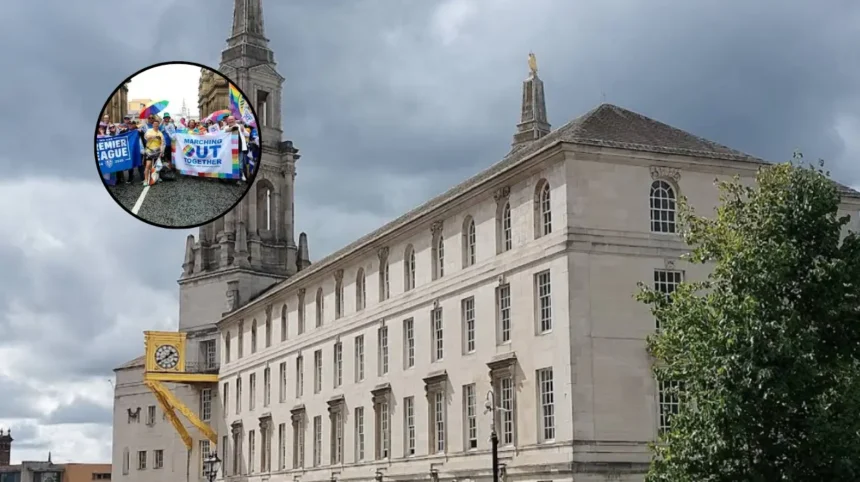
Leeds City Council (The Leeds Times) July 15, 2026 –Leeds City Council looks forward to celebrating 20 years of Leeds Pride on Sunday 19 July, with organisers expecting the city-centre event to attract more than 60,000 people. The parade will assemble opposite Leeds Town Hall and set off at 12:30pm, making its way down to Lower Briggate, while council representatives and the LGBT+ staff network have publicly shown their backing for the anniversary celebrations.
- Key Points
- What accessibility measures are in place for people attending Pride this year?
- How does the council describe its longer-term commitment to LGBT+ inclusion in Leeds?
- What is the historical background of Leeds Pride and how has it grown since it began?
- Who has spoken publicly about Pride and what did they say?
- Background
- Prediction: How this development can affect residents, visitors and the LGBT+ community in Leeds
As reported by Leeds City Council, the leader of the council, Councillor James Lewis, joined members of the council’s LGBT+ staff network earlier this week outside the Civic Hall to demonstrate support for Leeds Pride. Councillor Emma Flint, the council’s executive member for equality, adults and health, said the authority is proud to host one of the UK’s largest Pride events and reaffirmed the council’s ongoing work to make Leeds an LGBT+ inclusive city.
What accessibility measures are in place for people attending Pride this year?
Leeds City Council has confirmed a number of accessibility measures for Pride attendees. The council will contribute an access bus which will take part in the parade; spaces on the bus must be booked in advance.
There will be a raised accessible viewing area (AVA) in Millennium Square reserved for disabled people and their carers. Adjacent to that AVA is a changing places toilet and other disabled toilets.
The permanent toilet provision beneath Millennium Square will also be available. Lower Briggate will feature its own AVA with a dedicated accessible toilet provision.
How does the council describe its longer-term commitment to LGBT+ inclusion in Leeds?
The council points to the 2024–2029 LGBT+ Inclusive Leeds plan as a formal reaffirmation of its commitment to LGBT+ inclusive support across the city.
Leeds City Council also runs an LGBT+ hub which provides a forum for the LGBT+ community to engage with council services, statutory and voluntary sector partners, and the business community — offering opportunities to speak to, hear from, and provide feedback about how services and policies are shaped.
The council directs the public to its online LGBT+ Hub pages for further information: LGBT+ Hub | Leeds.gov.uk.
What is the historical background of Leeds Pride and how has it grown since it began?
Leeds Pride can trace its official beginnings to August 2006, when the first formal event was held with the support of Leeds City Council and local businesses. Contemporary council material notes around 6,500 people attended that inaugural event.
Over the following two decades the event has expanded in scale and profile to become one of the larger Pride events in the UK, attracting tens of thousands of participants and spectators.
Who has spoken publicly about Pride and what did they say?
As reported by Leeds City Council, Councillor Emma Flint said:
“We’re proud to be the host city of one of the largest Pride events in the UK, and every year we just love seeing so many people come together to celebrate equality and our vibrant LGBT+ community. We know that the community faces inequalities and discrimination and we continue to work hard for Leeds to be a truly LGBT+ safe and inclusive city.”
Councillor James Lewis and members of the council’s LGBT+ staff network also gathered outside the Civic Hall earlier this week to demonstrate the council’s support.
Explore More Leeds City Council
Safety Fears Restrict Nighttime Access to Parks in Leeds and Bradford 2026
Civic Leaders Mark Solemn Srebrenica Memorial Ceremony in Leeds 2026
Background
Leeds Pride’s evolution from a modest community gathering into a major city-centre event reflects broader social and political changes around LGBT+ visibility and rights in the UK.
The first official Pride in Leeds in August 2006 drew around 6,500 people, a number that has risen steadily in subsequent years as the event gained local business and civic backing.
Leeds City Council’s development of formal programmes — including the LGBT+ hub and, most recently, the 2024–2029 LGBT+ Inclusive Leeds plan — demonstrates a municipal approach focused on engagement, policy development and targeted access provisions such as the AVAs and the access bus.
These civic structures aim to provide routes for community feedback into public services while also ensuring practical measures for inclusion at large public events.
Prediction: How this development can affect residents, visitors and the LGBT+ community in Leeds
- Community visibility and participation: A well-attended 20th-anniversary Pride will likely amplify visibility for Leeds’ LGBT+ community, reinforcing civic recognition and encouraging wider public participation in equality-focused activities.
- Access and inclusion outcomes: The council’s provision of AVAs, changing places facilities and an access bus should improve event accessibility for disabled attendees and carers. Clear booking processes and on-site signage will be important to ensure those benefits reach the intended users.
- Policy and service engagement: Continued promotion of the LGBT+ hub and the 2024–2029 plan may increase community interaction with council services, potentially generating more user feedback that could shape future policies and service delivery.
- Local economy and city profile: Large visitor numbers typically boost local businesses — hospitality, retail and transport — during the event. Hosting a high-profile anniversary Pride can reinforce Leeds’ reputation as an inclusive city, which may have longer-term benefits for tourism and civic branding.
- Safety and crowd management implications: A significant attendance figure requires robust crowd management, healthcare and policing plans. Effective coordination by the council and emergency services will influence attendees’ experience and perceptions of safety.
- Long-term social impact: Sustained civic support combined with accessible programming may gradually reduce barriers to participation for marginalised community members. However, realising that outcome will depend on ongoing commitment to both symbolic and practical measures beyond the event itself.