

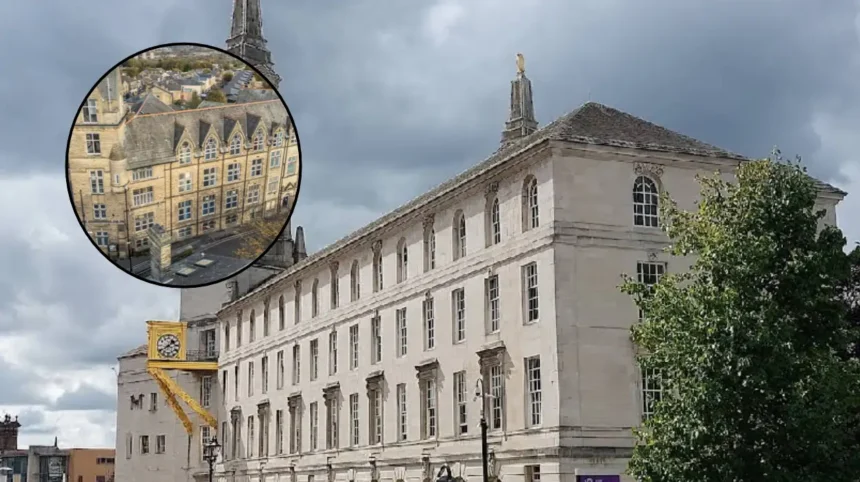
Key Points
- Manchester-based property developer AGHA Group has acquired the 21,500 sq ft Pudsey Town Hall from Leeds City Council.
- The 1880-built asset was put on the market via property firm Lambert Smith Hampton in January, despite local opposition and a petition signed by over 1,000 people.
- Purchase details revealed that the total transaction value reached £598,000 once fees were included.
- Leeds City Council declared the building surplus to requirements, citing that it had been vacant since roughly 2020 and was costing money to maintain.
- The four-storey Gothic-style building was originally constructed for the local Mechanics’ Institute before becoming the headquarters for Pudsey Borough Council in the early 1900s.
Pudsey (The Leeds Times) September 25, 2026.The 21,500 sq ft building was removed from Leeds City Council’s asset roster following a disposal process led by property consultancy Lambert Smith Hampton (LSH). Purchase records indicate that the final deal reached £598,000 in total once transaction fees were incorporated.
As detailed by Sally Gibson of Place Yorkshire, Leeds City Council formally declared the property surplus to operational requirements after remaining vacant since around 2020. LSH was officially instructed to handle the disposal of the nineteenth-century asset.
Richard Corby, senior director at Lambert Smith Hampton, previously noted during the marketing phase that the agency called for unconditional freehold offers to be submitted by February 12, 2026, aiming to finalise the transition swiftly.
What is the architectural and historical significance of the building?
Constructed in 1880, the landmark building spans four principal floors and occupies a prominent corner position featuring three road frontages.
According to historical assessments outlined by Lambert Smith Hampton and reported by Place Yorkshire, the structure was originally built to house the local Mechanics’ Institute. In the early 1900s, it transitioned into the headquarters for Pudsey Borough Council, continuing to host vital civic functions for decades thereafter.
The building was designed by Bradford-based architectural firm Hope & Jardine, incorporating a distinctive Gothic style that utilizes traditional stone masonry alongside intricate architectural elements. Notable physical features highlighted by property marketers include an arched main entrance, period stone detailing, large sash windows across the upper floors, and an internal main feature staircase.
Why did the sale face local controversy and community resistance?
The disposal of the historic civic asset proceeded despite significant pushback from local residents, community groups, and local politicians.
As reported by Sally Gibson of Place Yorkshire, LSH was instructed to lead the sale “despite a petition signed by more than 1,000 people who wanted the council to retain the asset”. Local reports indicated that cash-strapped Leeds City Council faced intense financial pressures, influenced by rising costs in social care and long-term funding constraints, prompting the local authority to offload underutilised properties to balance its books.
Alternative community proposals—including efforts by the Pudsey Town Hall Community Interest Company (CIC) to transform the building into a mixed-use community and enterprise hub—ultimately missed out as the council moved forward with commercial bids.
Community stakeholders and local representatives expressed disappointment that alternative community-led schemes capable of preserving public access to the civic heritage floor were bypassed in favour of conversion plans.
Explore More Pudsey News
Pudsey Town Hall Sold to Developer for £575,000 in Pudsey 2026
Pudsey Masonic Hall Air Conditioning Approved, Pudsey 2026
Background of the Particular Development
The sale of Pudsey Town Hall forms part of a wider trend of local authorities across the United Kingdom offloading historic civic real estate to manage budget deficits. Leeds City Council, like many municipal bodies, has faced severe financial challenges over the past decade and a half, driven by reductions in central government funding and escalating demands within statutory services such as adult social care.
Because buildings like Pudsey Town Hall—vacant since approximately 2020 and requiring substantial maintenance investment—no longer served active administrative purposes, councils have increasingly relied on commercial disposals. Engaging agencies like Lambert Smith Hampton allows local authorities to quickly liquidate capital assets, though this frequently triggers friction with local preservationists and community groups who view these Victorian-era buildings as core elements of local identity and public heritage.
Prediction on How This Development Can Affect the Local Community
The acquisition and planned conversion of Pudsey Town Hall by a commercial developer will likely alter the architectural and social fabric of Pudsey town centre. For local residents and community stakeholders, the shift from a civic administrative hub to a residential or mixed-use commercial space closes the chapter on public municipal access for the historic structure.
While the injection of private capital may breathe new physical life into a vacant building and prevent structural dereliction, local community groups will need to monitor how thoroughly the new owners protect the Gothic exterior, the arched main entrance, and interior heritage features like the main feature staircase. Ultimately, the transition marks a permanent decentralisation of historic municipal property into private hands, reflecting the changing economic realities of local governance.