
Horsforth is a historic settlement in the north-west of Leeds, West Yorkshire. Its heritage reflects more than 900 years of documented history, with evidence of medieval landholding, monastic influence, farming, water-powered industry, religious development, transport expansion and Victorian growth.
- What is the history of Horsforth?
- How did Kirkstall Abbey influence Horsforth?
- What can you see at Low Hall in Horsforth?
- What remains of Horsforth Hall?
- Why is St Margaret’s Church important to Horsforth heritage?
- What historic buildings can you see around Town Street?
- What is the history of the Mechanics Institute in Horsforth?
- What does Horsforth Station tell visitors about local history?
- Where can you find evidence of Horsforth’s industrial heritage?
- Which smaller heritage buildings are worth noticing in Horsforth?
- How do Horsforth’s conservation areas protect local heritage?
- How should visitors explore Horsforth’s historic places?
- Why does Horsforth’s heritage remain important today?
- What makes Horsforth a useful heritage destination in Leeds?
The area retains historic buildings across its streets and former rural edges. Low Hall, the former Horsforth Hall stable block, St Margaret’s Church, Station House, Mill Fold and historic buildings around Town Street each represent a different period of local development.
Leeds City Council recognises Horsforth and Horsforth Cragg Hill as conservation areas. Conservation areas protect places where groups of buildings, streets, spaces and landscapes have a special architectural or historic character.
For visitors, this makes Horsforth suitable for heritage-focused walking and independent exploration. Many important buildings remain part of the living neighbourhood rather than operating as dedicated tourist attractions. Their surroundings provide context for understanding how Horsforth developed from a rural township into a modern Leeds suburb.
What is the history of Horsforth?
Horsforth’s heritage spans medieval settlement, monastic landholding, farming, industry, transport and Victorian expansion. Historic places include Low Hall, Horsforth Hall’s stable block, St Margaret’s Church, Town Street buildings, Station House, Mill Fold, and surviving conservation areas today.
The earliest surviving documentary evidence comes from the Domesday Survey of 1086. Leeds Council’s heritage assessment states that Horsforth was recorded in Domesday and valued at 30 shillings. The settlement had previously been associated with three Anglo-Saxon thegns, or landholding nobles.
The name Horsforth is generally connected with Old English words referring to a horse ford. Leeds Council notes that the exact location of the historic ford is no longer known. The River Aire and its valley were important geographical features in the development of the settlement.
Horsforth’s medieval history became closely connected with Kirkstall Abbey after the Cistercian monastery was established in 1152. Monastic ownership transformed land use in the area, with agricultural land supporting the abbey and its wider estate.
After the Dissolution of the Monasteries under Henry VIII, Kirkstall Abbey was closed in 1539 and its lands were sold to private owners. The change transferred important landholdings into private hands and influenced the development of later estates and buildings in Horsforth.
By the seventeenth and eighteenth centuries, Horsforth remained strongly agricultural. At the same time, population growth, textile work, milling and improved transport gradually changed the character of the settlement.
How did Kirkstall Abbey influence Horsforth?
Kirkstall Abbey influenced Horsforth through medieval land ownership, agricultural administration and economic activity. Cistercian monks established a grange, or monastic farm, in the township, while later land sales after the 1539 Dissolution transferred former abbey property to private owners.
The Cistercian monks of Kirkstall Abbey became major landowners in Horsforth. Leeds Council’s historical assessment records that a large area on the northern edge of the township became a grange, meaning a monastic agricultural estate. Local people worked the land and generated agricultural income for the abbey.
The former monastic farm is associated with the area around Dean Grange Farm. Leeds Council records that no surviving medieval structures have been confirmed at the site, although earthworks in adjacent fields have been considered possible evidence of earlier buildings.
This history explains why Horsforth contains references to former agricultural estates and why some present-day roads and fields follow older patterns of land use.
The Dissolution of Kirkstall Abbey in 1539 marked another major stage. Former monastic lands were sold to private landowners, including members of the Stanhope family. The Stanhopes subsequently became important landowners in Horsforth and were associated with local religious and residential development.
The connection between monastic ownership and later private estates is important when exploring Horsforth today. Historic buildings are not isolated structures. They represent successive changes in land ownership, farming, religion and local administration.
For visitors interested in the wider medieval story, [Insert Anchor Text for History Article Here] provides the appropriate historical background for understanding how Horsforth developed before its later Victorian expansion.
What can you see at Low Hall in Horsforth?
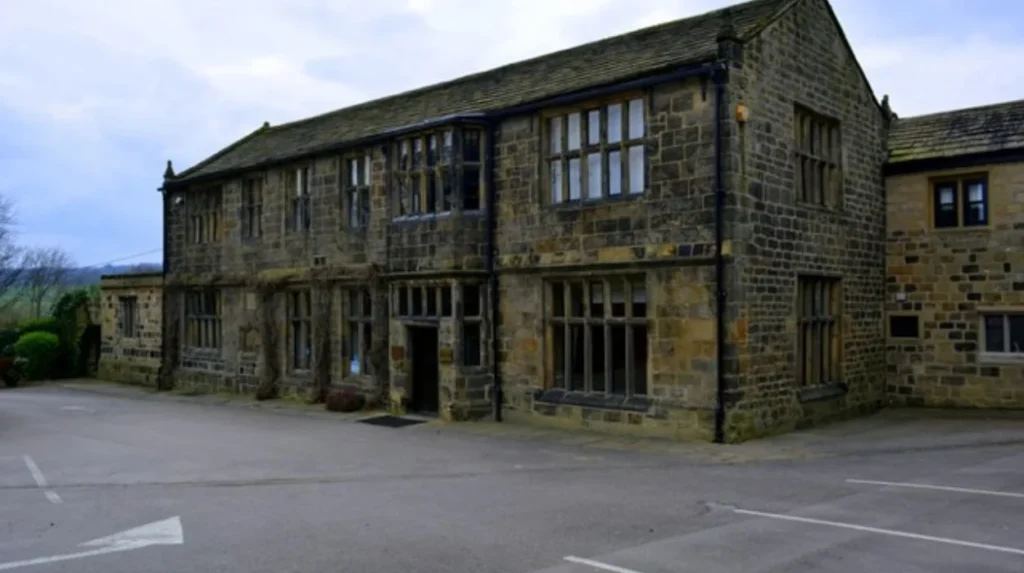
Low Hall is one of Horsforth’s most significant surviving historic houses. Historic England dates its fabric to several periods from the mid-to-late sixteenth century, with most of the present manor house dating from the later seventeenth century and links to the Stanhope family.
Low Hall stands on Low Hall Road and is a Grade II listed building. Historic England records its first listing date as 19 October 1962. The National Heritage List identifies it as a manor house and farmhouse with fabric from several periods.
The building contains architectural evidence from different stages of development. Historic England identifies parts dating from the mid-to-late sixteenth century, while the main house is largely associated with the later seventeenth century.
Its architecture includes sandstone construction, mullioned windows, Tudor-arched doorways and later alterations. A mullioned window is a window divided vertically by stone or timber members called mullions. These details help identify the building’s earlier architectural character.
The property was associated with the Stanhope family, an important landowning family in Horsforth. The building therefore connects domestic architecture with the changing ownership structure of the township after the Dissolution.
A historic barn survives close to Low Hall Farmhouse. Historic England records the former barn as probably dating from the earlier seventeenth century. It is an aisled barn constructed from coursed squared sandstone with a stone slate roof.
Low Hall is particularly important because the surrounding buildings demonstrate how a historic estate included both a principal house and agricultural structures. The combination provides evidence of how farming and domestic life operated together.
What remains of Horsforth Hall?
Horsforth Hall’s surviving stable block is a Grade II listed building on Hall Lane. Historic England dates the structure mainly to the later eighteenth century while recording a 1707 datestone, sandstone construction, a stone slate roof, and historic openings including a sundial feature.
The former Horsforth Hall estate once formed an important part of the local landscape. The surviving stable block is now one of the clearest physical reminders of the estate.
Historic England lists the stable block at Grade II under entry number 1261240. The building was first listed on 7 April 1988. Its construction is mainly later eighteenth century, although a carved datestone records the year 1707.
The building has a rectangular plan and two storeys. Its walls use coursed squared sandstone, while the roof is covered with stone slate. Historic openings include tall doorways, windows and a wall sundial.
The stable block demonstrates how large historic houses depended on supporting buildings. Stables provided accommodation for horses, equipment and associated estate activities. The surviving structure therefore contributes to understanding the practical organisation of an eighteenth-century landed estate.
Horsforth Hall Park also forms part of the historic landscape associated with the former hall. Leeds Council’s heritage documentation identifies the park as a green space within Horsforth’s historic environment.
The site is useful for visitors who want to understand the relationship between historic buildings and public landscape. The surviving stable block, surrounding streets and parkland together provide a clearer picture than viewing the building in isolation.
Why is St Margaret’s Church important to Horsforth heritage?
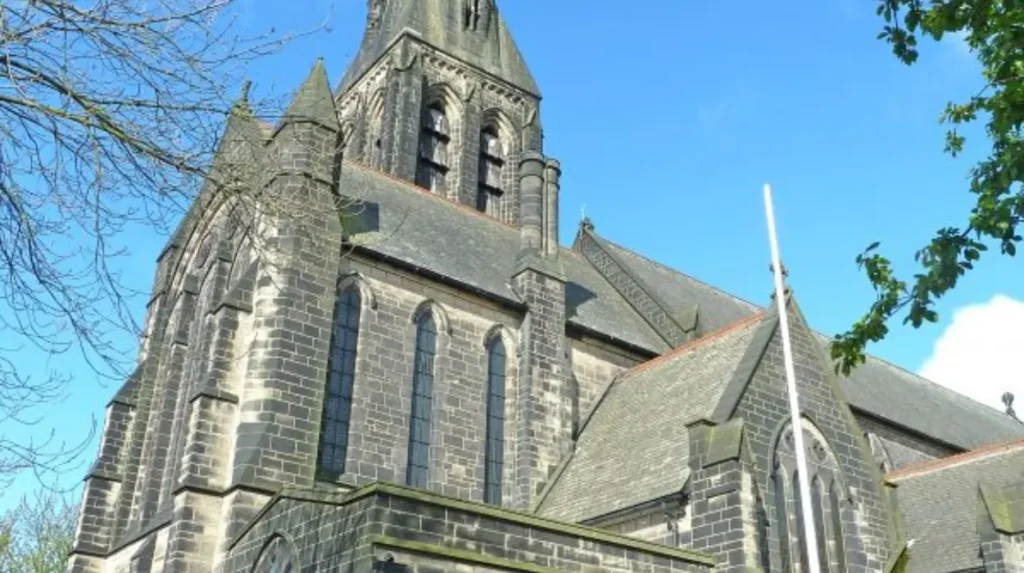
St Margaret’s Church represents Horsforth’s Victorian expansion and ecclesiastical history. Designed in 1874–76 and built between 1877 and 1883, it replaced the earlier Bell Chapel because the older building was too small for the growing congregation and became a prominent landmark.
St Margaret’s Church stands on Church Lane and is a Grade II listed building. Historic England records the church as an important example of Victorian ecclesiastical architecture associated with Horsforth’s population growth.
The present church was designed in 1874–76 and constructed between 1877 and 1883. Its development followed the limitations of the earlier Bell Chapel, which had undergone repeated alterations and enlargement but remained too small for the growing congregation.
The church therefore represents more than religious history. It records the physical expansion of Horsforth during the nineteenth century.
Its location is also historically significant. When the church was built, it stood relatively apart from the established village core, on the lower slopes of the Hunger Hills. The surrounding development later expanded towards it.
Visitors should also recognise the earlier religious history represented by the Bell Chapel. The chapel was connected with the local community before the construction of the larger Victorian church.
St Margaret’s demonstrates how population growth changes the built environment. Larger congregations require larger buildings, and new churches often become landmarks within expanding settlements.
What historic buildings can you see around Town Street?
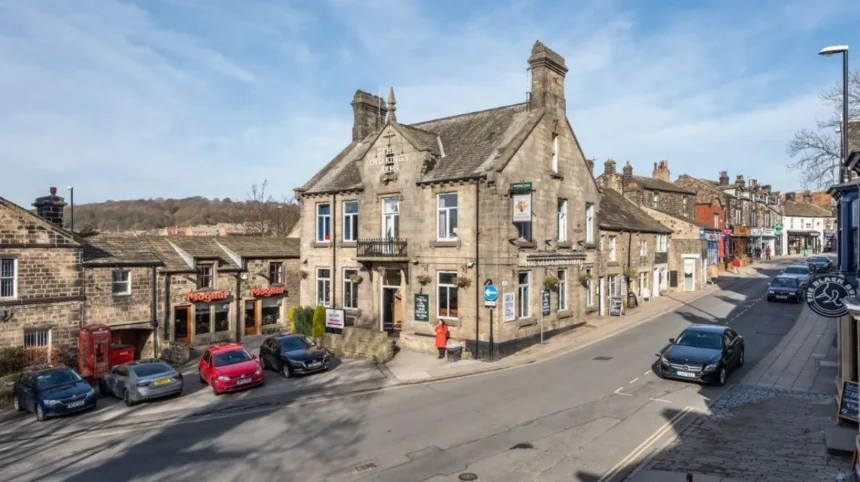
Town Street contains a concentrated group of historic buildings that shows Horsforth’s village character before suburban expansion. Leeds records eighteenth-century sandstone cottages, former farmhouses, Croft House, Grove Manse, the Mechanics Institute, and Grove Methodist Church among its heritage assets.
Town Street remains one of the most useful areas for understanding historic Horsforth through everyday architecture. Rather than focusing on one landmark, visitors can observe groups of buildings representing different periods and functions.
Leeds Council identifies several listed buildings and historic structures along Town Street. These include numbers 123–135, a row of seven stone cottages dating from the eighteenth century and originally associated with a farmhouse and outbuildings.
Numbers 79, 81 and 83 form another group of late eighteenth-century stone cottages. Croft House at 155 Town Street dates from the mid-to-late eighteenth century and is constructed in sandstone.
Grove Manse is an early-to-mid eighteenth-century sandstone building. Nearby Grove Methodist Church dates from 1867 and represents the later religious development of the settlement.
These buildings demonstrate the gradual transition from a village based on farming and local trades towards a more developed urban community.
The use of local sandstone is particularly significant. Stone buildings created a consistent architectural character across parts of Horsforth and remain a defining feature of its historic streetscape.
Explore More Area Guide
Garforth Half-Day Itinerary for a Quick Visit 2026
Garforth Picnic Locations & Outdoor Relaxation Spots 2026
What is the history of the Mechanics Institute in Horsforth?
The Mechanics Institute is a major nineteenth-century community building on Town Street. Constructed in 1881 and opened in 1882, it provided an educational and civic facility and later accommodated library, council and community functions within Horsforth’s changing public infrastructure.
The Mechanics Institute forms part of Horsforth’s civic heritage. Leeds Council records that construction took place in 1881 and that the building opened in 1882.
Mechanics’ institutes developed across Britain during the nineteenth century to provide education and learning opportunities, particularly for working people. They became important community institutions during industrialisation.
Horsforth’s building demonstrates the increasing importance of education and organised public services within a growing settlement. Its history also illustrates how historic buildings can change function while retaining their architectural importance.
The building originally included the town’s police station on its right-hand side. That structure was later demolished, with replacement library and council facilities introduced in 1975. Leeds Council records that the top floor retains a former ballroom with a sprung dance floor and capacity for 90 people.
The building therefore connects nineteenth-century education and civic life with modern community services.
What does Horsforth Station tell visitors about local history?
Station House records the connection between Horsforth’s agricultural past and railway development. Historic England identifies its barn as late seventeenth century, the house as early-to-mid eighteenth century, and its later role as the station master’s residence after Horsforth station opened in 1849.
Station House stands near Horsforth station and provides a direct physical link between pre-railway Horsforth and nineteenth-century transport development.
Historic England records that the property began as a farmhouse with an attached barn and cottage. The barn dates from the late seventeenth century, while the house was built during the early-to-mid eighteenth century and enlarged during the nineteenth century.
The property later became the station master’s house. Historic England records John Ambrose Gott as station master in 1881, living there with his wife and five children. His son Herbert worked as a railway clerk.
Horsforth station opened in 1849 on the Leeds to Harrogate line. The original station buildings were demolished in 1969 during widespread railway rationalisation in West Yorkshire. New waiting rooms and a ticket office were constructed in 2002–03.
This makes Station House especially valuable because it survives even though the original station buildings do not.
The railway changed Horsforth’s relationship with Leeds and surrounding communities. Faster transport supported commuting, trade, employment and suburban expansion.
Where can you find evidence of Horsforth’s industrial heritage?
Mill Fold preserves evidence of Horsforth’s water-powered industrial development. Leeds Council’s conservation assessment records an eighteenth-century water corn mill built by William Wright between 1772 and 1797 on an earlier seventeenth-century farm holding, with the complex operating through the nineteenth century period.
Mill Fold represents the transition from agricultural landholding towards mechanised local production.
Leeds Council’s conservation assessment identifies an eighteenth-century water corn mill at Mill Fold. The mill was built by William Wright between 1772 and 1797 on the site of a smaller seventeenth-century farm holding.
A water corn mill used flowing water to power machinery for processing grain. Such mills were important because they converted natural water power into mechanical energy before modern industrial electricity became widespread.
The Mill Fold complex continued operating through the nineteenth century. Its history therefore covers a period when Horsforth was experiencing wider economic and population changes.
The site also demonstrates why the Aire valley was important to local development. Water availability supported industrial activity, while nearby roads and settlements provided access to workers and markets.
Horsforth’s industrial heritage is not limited to large factories. Smaller mills, workshops, farms and transport infrastructure contributed to the economic transformation of the settlement.
Which smaller heritage buildings are worth noticing in Horsforth?
Several smaller historic places help explain Horsforth’s social and religious development, including Woodside Methodist Sunday School and Hall, New Laithes Manor House, Upper Bank House, and the Toll House associated with Iron Bridge. Their different dates and functions reveal changing local needs.
Woodside Methodist Sunday School and Hall on Outwood Lane is Grade II listed. Historic England records an early nineteenth-century school with an attached chapel dated 1839. The building is constructed from coursed squared sandstone with slate and stone slate roofing.
New Laithes Manor House is another listed historic building associated with Horsforth’s earlier residential and agricultural landscape. Historic England records it as a Grade II listed building.
Upper Bank House on Drury Lane represents late eighteenth-century domestic architecture. Historic England describes it as a sandstone house with a classical design, including an Ionic porch, sash windows and a moulded cornice.
The Toll House at Iron Bridge provides evidence of nineteenth-century transport infrastructure. Historic England dates the associated bridge and toll house to around 1819. The building is constructed from coursed squared sandstone and has a slate roof.
These buildings demonstrate that heritage extends beyond major churches and manor houses. Schools, chapels, homes, bridges and toll facilities all document how communities functioned.
How do Horsforth’s conservation areas protect local heritage?
Horsforth’s conservation areas protect the character of historic streets, buildings, spaces and landscapes as groups rather than treating every structure separately. Leeds identifies Horsforth and Horsforth Cragg Hill as conservation areas, supporting long-term management of their architectural and historic character.
Conservation areas are designated by local planning authorities under the Planning (Listed Buildings and Conservation Areas) Act 1990. Their purpose is to protect areas with special architectural or historic interest.
Leeds Council lists both Horsforth and Horsforth Cragg Hill among its designated conservation areas. The council provides appraisal documents and area maps as part of its heritage and planning framework.
The conservation approach is important because historic character often depends on relationships between buildings, roads, walls, gardens, open spaces and views.
A single eighteenth-century building provides architectural evidence. A whole historic street provides evidence about settlement patterns, building materials, movement and social organisation.
Horsforth Cragg Hill also retains evidence of its former rural character. Leeds Council’s conservation assessment records Crag House as a Grade II listed farmhouse with seventeenth-century origins.
Visitors can therefore gain more from observing the complete streetscape rather than focusing only on buildings that appear on heritage registers.
How should visitors explore Horsforth’s historic places?
Visitors can explore Horsforth’s heritage without treating the area as a formal museum. Walking through Town Street, Hall Lane and nearby heritage areas reveals historic stone buildings, former farmsteads, religious sites, transport infrastructure and landscape features, with public access varying by property.
A heritage walk can begin around Town Street, where groups of eighteenth- and nineteenth-century buildings demonstrate the historic village core. From there, visitors can examine the Mechanics Institute and nearby religious buildings.
Hall Lane provides access to the historic landscape associated with Horsforth Hall. The surviving stable block should be viewed from publicly accessible areas because listed status does not automatically mean that a building is open to visitors.
Low Hall Road provides another route into the historic environment around Low Hall. The listed house and associated agricultural structures demonstrate the relationship between manor houses and farming.
Church Lane provides access to the setting of St Margaret’s Church. Visitors should check current opening arrangements before entering religious buildings.
Station Road provides a direct connection with railway heritage and Station House. The current railway station provides modern transport access while the surviving historic house represents an earlier phase of the site.
The Aire-side landscape and Mill Fold area add evidence of industrial and agricultural development. Public access varies across private land, operational sites and community spaces, so visitors should remain on permitted routes.
Horsforth is therefore best approached as a historic landscape. Its heritage is distributed across streets, buildings and open spaces rather than concentrated inside one attraction.
Why does Horsforth’s heritage remain important today?
Historic Horsforth remains relevant because listed buildings and conservation areas preserve evidence that cannot be recreated once lost. Heritage protection identifies buildings and places with special interest, while careful use allows historic structures to remain part of everyday community life.
Horsforth’s historic environment records the physical development of the settlement over many centuries. The evidence includes medieval landholding, post-Dissolution estates, agricultural buildings, eighteenth-century homes, industrial sites, religious buildings and railway infrastructure.
Historic England’s National Heritage List for England provides statutory records for listed buildings and other designated heritage assets. Listed buildings are protected because of their special architectural or historic interest.
The Grade II listing of buildings such as Low Hall and the Horsforth Hall stable block ensures that their significance is formally recognised within the planning system.
Heritage also contributes to local identity. Historic buildings provide evidence of previous generations, occupations and community institutions. They help residents and visitors understand why streets and neighbourhoods developed in their present form.
The continued use of historic buildings is particularly important. The Mechanics Institute has evolved into a community facility, while other historic properties have been adapted for residential, commercial or community purposes.
This combination of protection and continued use gives Horsforth’s heritage practical relevance. The buildings remain part of the town rather than becoming disconnected monuments.
What makes Horsforth a useful heritage destination in Leeds?
Horsforth offers a compact heritage landscape where medieval origins, monastic history, historic estates, Victorian architecture, industrial development and railway expansion can be examined within one Leeds neighbourhood. Its surviving buildings provide clear evidence of changing local society and settlement patterns.
The strongest feature of Horsforth’s heritage is its chronological variety. Visitors can identify evidence from several centuries without travelling between distant parts of Yorkshire.
Low Hall represents early domestic and estate architecture. The Horsforth Hall stable block represents later estate development. Town Street preserves the character of the historic village. St Margaret’s Church records Victorian population growth. Station House connects earlier farming with railway expansion. Mill Fold demonstrates water-powered industry.
The conservation areas provide the wider setting that connects these individual places.
For tourists and leisure travellers, this creates opportunities for walking-based exploration. Residents can use the same streets and landmarks to understand the history of their neighbourhood. Digital nomads and business travellers with limited free time can combine heritage walks with Horsforth’s modern cafés, shops and community facilities.
Horsforth’s heritage also provides a useful case study of wider urban change in West Yorkshire. The settlement moved from medieval agricultural landholding through monastic control, private estates, farming, industry and railway development before becoming part of the metropolitan Leeds area.
That layered history remains visible in sandstone buildings, historic road patterns, churches, former farmsteads, industrial sites and transport infrastructure.
The result is a heritage landscape that can be explored gradually. A short walk around Town Street reveals one part of the story, while a longer route towards Hall Lane, Low Hall, Church Lane or the railway reveals additional periods of development.
Visitors should treat each building as part of this wider historical sequence. Horsforth’s most important heritage feature is not one isolated monument, but the surviving relationship between its historic buildings, streets and landscapes.
What is the oldest historic place in Horsforth?
Low Hall is one of Horsforth’s oldest surviving historic buildings, with parts dating from the mid-to-late 16th century. The area itself has much earlier origins, with Horsforth recorded in the Domesday Survey of 1086.