
Key Points
- Thousands of council staff in Leeds are being balloted on potential strike action following a dispute over equal pay.
- The GMB union reported that the action was triggered by a lack of decisive movement from Leeds City Council regarding fair wages for female workers.
- More than 4,000 women have joined the equal pay claim against the local authority.
- Disparities have been identified between roles predominantly staffed by women, such as teaching assistants, and roles mainly staffed by men, such as refuse collectors.
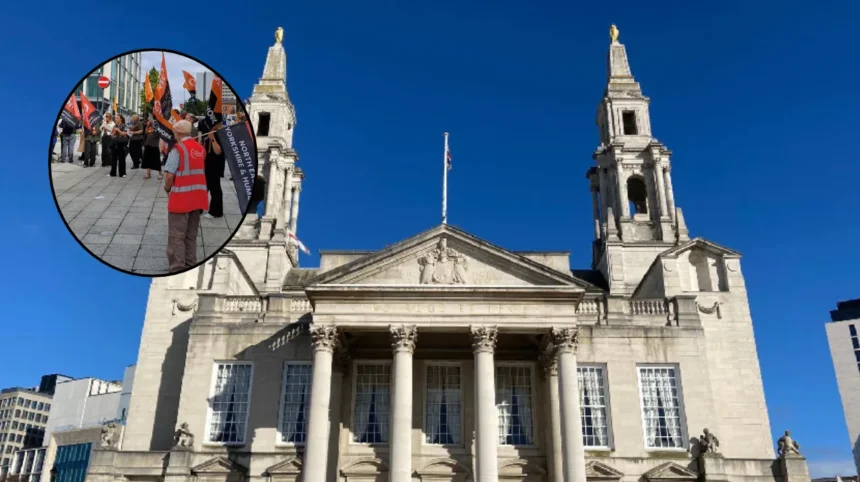
- Union members staged a demonstration outside Leeds Civic Hall during a full council meeting.
- The indicative ballot is scheduled to open on Friday, September 18, coinciding with International Equal Pay Day.
Leeds (The Leeds Times) September 14, 2026 — Thousands of council staff will be balloted on possible strike action in an escalating dispute over equal pay, local reports indicate. As reported by journalist Don Mort of the Local Democracy Reporting Service (LDRS), the GMB union stated that the ballot was triggered directly by a perceived lack of action from Leeds City Council concerning fair wages for female employees.
Why Are Leeds Council Staff Being Balloted on Strike Action?
The GMB union has confirmed that more than 4,000 women have joined an official equal pay claim against Leeds City Council. According to findings highlighted by the union, systematic pay differences exist between jobs predominantly staffed by women—such as teaching assistants—compared to predominantly male roles, such as refuse collection.
As reported by Don Mort of the LDRS, frustration boiled over when union members staged a noisy protest outside Leeds Civic Hall while a full council meeting was taking place inside. GMB organiser Lee Parkinson addressed the breakdown in discussions, stating that negotiations had fallen through. As reported by Don Mort of the LDRS, Mr Parkinson announced:
“Negotiations have fallen. We are going to ballot for strike action on Friday, September 18.”
Mr Parkinson further emphasised the union’s desire for a peaceful resolution, urging the local authority to return to discussions. As reported by Don Mort of the LDRS, Mr Parkinson stated:
“As everybody has heard, we want them to get back around the table and settle this dispute amicably, and resolve this pay injustice for our members who are suffering.”
What Are the Next Steps for the GMB Union Ballot?
The upcoming ballot is an indicative consultation asking members whether they would be prepared to take industrial action in principle. If a sufficient majority votes in favour, it could pave the way for a formal, full strike ballot.
According to GMB senior organiser Julie Wynn, the timing of the ballot launch holds symbolic and practical significance. As reported by Don Mort of the LDRS, Ms Wynn stated that the ballot would open on International Equal Pay Day. Elaborating on the sentiment among the workforce, Ms Wynn stated, as reported by Don Mort of the LDRS:
“These women are owed millions of pounds and they want to see some action. Leeds City Council has made plenty of noises about doing the right thing, but so far absolutely nothing has happened. So they have asked for an indicative ballot – and if they win that, the next step is a full strike ballot. Leeds council’s working women are not going to back down from this fight.”
Previously, the GMB warned that resolving the expansive equal pay claim could ultimately cost the local authority hundreds of millions of pounds.
How Has Leeds City Council Responded to the Claims?
Leeds City Council has been approached for detailed comment regarding the launching of the ballot. In previous statements addressing the ongoing negotiations, the local authority maintained that it remained keen to continue talks. Furthermore, council representatives noted that the outstanding elements of the GMB claim involved complex legal issues that require careful navigation.
Explore More Leeds City Council News
New Council Flats Plans Submitted for Farsley 2026
Background of the Particular Development
Equal pay disputes within local government bodies across the United Kingdom frequently stem from historical job evaluation schemes designed to harmonise pay scales between different sectors of municipal work.
Over recent years, multiple major local authorities—including Birmingham City Council and Glasgow City Council—have faced multi-million-pound liabilities after tribunals or union campaigns found that female-dominated roles like catering, cleaning, and teaching support were undervalued compared to male-dominated manual roles.
In the case of Leeds City Council, tensions have simmered as the GMB union pushed for accelerated settlements for thousands of affected administrative, educational, and care staff. While some preliminary elements of claims were discussed or partially resolved in prior periods, the persistence of broader structural wage discrepancies has continually strained industrial relations.
The decision to escalate toward an indicative ballot reflects mounting impatience among municipal workers who argue that administrative delays prolong systemic financial inequality.
Prediction
This developing industrial dispute carries significant implications for local government operations, public service delivery, and municipal finance within West Yorkshire. If the GMB secures a strong mandate in the upcoming indicative ballot and progresses to a formal strike, Leeds City Council could face widespread operational disruption across schools, administrative offices, and public services.
A strike involving thousands of workers would place immense pressure on council leadership to find a viable financial compromise, especially given that the potential liabilities run into hundreds of millions of pounds.
For local residents and taxpayers, an extended dispute risks disrupting daily council services and could severely constrain the local authority’s already tight budgetary framework. Conversely, a failure to reach an amicable settlement could trigger prolonged industrial unrest, setting a precedent for similar equal pay challenges across other UK local authorities grappling with parallel workforce disparities.