Key Points
- Elland Road Height Reduction: Leeds United AFC Ltd has submitted a non-material amendment to their major stadium redevelopment plans, proposing a smaller roof truss design that reduces the overall height of the structure by approximately 7.8 metres.
- Industrial Site Reconfiguration: An application has been validated to alter the use of Unit 1 Pioneer Place from office-supported storage and distribution to general industrial and storage use with employee space.
- Retrospective Sports Application: A retrospective change of use application has been lodged for a personal training space within an outbuilding at Hopewell View in Middleton.
- Residential Expansion in Beeston: Plans have been submitted for a part two-storey, part first-floor side and rear residential extension featuring an integrated carport on Grovehall Drive.
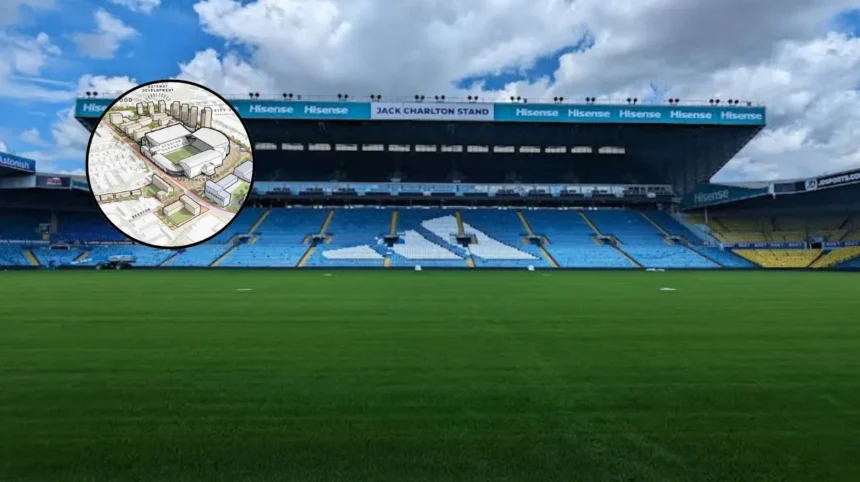
Leeds (The Leeds Times) June 22, 2026 — Leeds City Council has formally validated a series of distinct planning applications across the LS10 and LS11 postcode areas, highlighting a major structural modification to the multi-million-pound Elland Road stadium redevelopment alongside vital local commercial and residential adjustments. As recorded in the official weekly planning ledger published by the local authority for the week commencing 15 June 2026, the most significant public development involves a registered non-material amendment by Leeds United AFC Ltd. The football club has proposed an updated architectural design for its massive West and North Stand expansion, significantly downscaling the primary roof truss by approximately 7.8 metres in height compared to the previously sanctioned blueprints.
Alongside this high-profile sporting infrastructure amendment, the council’s planning portal confirmed the validation of three other applications aimed at modifying the urban fabric of South Leeds.
These include an industrial change of use at Pioneer Place in the LS10 sector, a retrospective application for a fitness business operating out of an outbuilding in Middleton, and a substantial two-storey residential extension in Beeston.
All four applications have entered the formal consultation phase, during which municipal officers, local residents, and statutory consultees will review the spatial, environmental, and economic impacts of the proposals before final administrative determinations are issued.
Why is Leeds United altering its multi-million-pound stadium redevelopment design?
As reported by municipal planning reporters tracking the Leeds City Council planning portal, the most prominent application validated during this period is registered under reference number 26/9/00102/MOD, submitted on behalf of Leeds United AFC Ltd for the historic Elland Road Stadium site (Beeston, Leeds, LS11 0ES).
The submission functions as a Section 96A non-material amendment to the previously approved hybrid planning application 25/04000/FU. The core of this new variation is an updated engineering design for the stadium’s primary roof truss.
According to the official project specifications uploaded to the council database, the revised roof truss is smaller in scale than the version originally permitted.
The mechanical and structural redesign results in a net height reduction of the entire roof truss assembly by approximately 7.8 metres. This alteration represents a noticeable visual and structural departure from the primary hybrid application, which mandates a comprehensive overhaul of the club’s infrastructure.
The overarching hybrid permission comprises several complex phases:
- West Stand Redevelopment: A full planning application for the partial demolition and complete reconstruction of the West Stand. This phase is designed to significantly increase stadium seating capacity and introduce state-of-the-art corporate hospitality suites, enhanced food and beverage concourses, dedicated retail units, and an official club museum.
- Transport and Access Logistics: Full planning permission for dedicated coach parking facilities, which includes permanent boundary treatments, heavy vehicle routing, and both hard and soft landscaping to buffer the transport hub from surrounding thoroughfares.
- Site Clearance: Total demolition of specified older auxiliary buildings and peripheral structures currently obstructing the footprint of the expanded stands.
- Temporary Management Works: Full planning application for temporary site works, including interim parking reallocations and baseline landscaping to manage match-day crowds during the heavy construction phases.
- North Stand Outline Strategy: An outline planning application for the future partial demolition and redevelopment of the North Stand, establishing the framework for additional stadium seating, hospitality lounges, and integrated food and beverage infrastructure.
By submitting this amendment, Leeds United AFC Ltd aims to streamline the structural weight and profile of the stadium roof, an alteration that structural engineers note can alleviate foundation loading requirements and modify the local skyline impact without reducing the internal seating capacity promised in the initial West Stand expansion briefs.
Commercial and Industrial Changes
Moving from sports infrastructure to sector-specific commercial logistics, Leeds City Council planners validated an application under reference 26/03062/FU on Tuesday 16 June 2026. The application relates to Unit 1 Pioneer Place, Leeds, LS10 1SE. The applicant seeks a formal Change of Use to alter the building’s permitted operational parameters.
Specifically, the proposal seeks to transition the property from its existing designation as a Class B8 (Storage or Distribution) facility with ancillary Class E(g)(i) (Office) use, into a dual-operational site classified under both Class B2 (General Industrial) and Class B8 (Storage or Distribution).
Furthermore, the application seeks to retain and adapt auxiliary Class E(g) permissions to ensure the continuation of on-site administrative offices and dedicated employee welfare spaces.
As detailed by local planning monitors, this shift to include a Class B2 designation allows for internal mechanical processes, assembly, or light manufacturing operations that were restricted under the previous storage-only mandate.
The inclusion of explicit employee space underscores an operational intent to increase on-site personnel density, transitioning the unit from a purely transactional transit warehouse into an active industrial workspace within the industrial corridor of LS10.
Retrospective Micro-Business Approvals
In the residential suburbs of LS10, a retrospective application was validated on Wednesday 17 June 2026 under reference number 26/02244/FU. Located at 11 Hopewell View, Middleton, Leeds, LS10 3TE, the application requests retroactive municipal authorisation for a change of use regarding an existing residential outbuilding.
The homeowner has converted the outbuilding from standard domestic storage into a dedicated personal training space. Because the physical conversion and business operations commenced prior to securing formal planning consent, this retrospective application serves to legalise the existing commercial activity under local authority guidelines.
Council officers will evaluate the application based on residential amenity, specifically examining whether the flow of fitness clients into a residential cul-de-sac creates adverse noise, parking congestion, or alters the domestic character of the Hopewell View estate.
Residential Extensions in Beeston
The final planning application validated during this weekly cycle addresses domestic housing stock in the LS11 area. Registered under reference 26/03045/FU on Thursday 18 June 2026, the application outlines plans for a substantial expansion of a semi-detached property located at 80 Grovehall Drive, Beeston, Leeds, LS11 7ET.
The homeowner has submitted detailed architectural drawings for a part two-storey, part first-floor side and rear extension.
A defining feature of this architectural blueprint is the integration of an open carport directly underneath the elevated first-floor side extension.
This design choice aims to maximize the property’s internal living space while preserving off-street vehicular parking within the property boundaries.
The multi-aspect extension will undergo standard spatial reviews to ensure it complies with local daylighting policies and does not cause undue overshadowing to adjacent properties on Grovehall Drive.
Background of the Particular Development
The validation of these planning applications occurs during a period of sustained urban regeneration and infrastructure stress across South Leeds. The LS10 and LS11 postcodes form a crucial economic zone that bridges the expanding city centre with suburban residential communities.
Historically, Elland Road has stood as a major focal point for regional infrastructure planning. The stadium, home to Leeds United AFC since the club’s foundation in 1919, has seen its surrounding areas targeted for large-scale masterplans involving transport hubs, park-and-ride facilities, and commercial developments.
The current hybrid application (25/04000/FU) represents the most aggressive expansion strategy for the stadium in decades, driven by a long-term vision to elevate match-day capacities toward 53,000 seats and modernise corporate revenue streams to match elite sporting standards.
Simultaneously, the industrial zones of LS10, such as Pioneer Place, have experienced a steady transition. As the UK logistics and manufacturing sectors adjust to supply chain demands, older storage facilities are increasingly being converted into dual-use light industrial hubs to accommodate localized manufacturing and tech-driven assembly.
This commercial pressure coexists alongside high demand for residential expansions in Beeston and Middleton, where homeowners frequently opt to extend existing properties rather than relocate, leading to a rise in complex multi-storey extensions and outbuilding conversions within dense residential zones.
Prediction and Audience Impact
The validation of these planning applications is expected to trigger distinct, measurable outcomes for residents, business operators, and sports fans across the South Leeds community.
For local residents living in Beeston and the immediate vicinity of Elland Road, the proposed 7.8-metre height reduction of the stadium’s primary roof truss is a significant structural modification. This reduction will directly lower the overall massing of the construction project, meaning the completed West Stand will have a less dominant visual impact on the local skyline.
For the immediate neighbours, this downscaling could mitigate daylight loss and reduce the perceived physical encroachment of the stadium structure. However, the continuation of the broader hybrid scheme means that local residents must still prepare for prolonged construction noise, heavy plant vehicle movements, and temporary traffic diversions over the multi-year development cycle.
For the business and commercial community in LS10, the conversion of Unit 1 Pioneer Place into a Class B2 industrial facility will likely stimulate local employment opportunities and increase daytime economic activity.
However, standard industrial usage typically introduces higher noise baselines, increased heavy goods vehicle (HGV) traffic, and potential environmental emissions compared to simple storage warehousing. Nearby firms and commuters may experience altered traffic dynamics along the local commercial roads.
In the residential quarters of Middleton and Beeston, the decisions on the micro-level applications will set local precedents.
Approval of the retrospective personal training space at Hopewell View could encourage similar home-based commercial conversions across the estate, potentially increasing daytime visitor traffic in residential zones. Meanwhile, the successful delivery of the large-scale extension on Grovehall Drive will serve as a visual template for modernizing and expanding the area’s older housing stock, illustrating how homeowners can maximize density while addressing parking requirements via integrated carport designs.